Showing posts with label family tree. Show all posts

Sunday, August 28, 2016

Sunday Search: A Local Family Reunion


In recent years I have gained a greater appreciation for our annual family gatherings. While it was a little different this year with regard to both place and time of year, it was still a great time catching up and simply seeing everyone in one place. Yesterday we gathered together and took the opportunity to talk and, more importantly, to listen about all that was going on in the family and all the unique experiences that each of us has had over the past year (and a half). It is interesting because we are actually quite the diverse group.

This year I was able to bring more than food to the ‘reunion’ as I had recently completed pulling together all of the information needed for my supplemental Sons of the American Revolution application. Thankfully, I was able to print out an extra copy before leaving the office on Friday which allowed me to go page by page, generation by generation, when explaining our patriotic lineage. This is another part of the process that I really enjoy as I could see their faces when I was able to uncover each piece of information and name of which they were previously unaware. It was the same look that I had when I originally discovered the information.

However, that was only secondary as it was family time to both talk about our lives and also remember some of the past times when we all got together for a day or two. This is the most important part and I have become more aware and appreciative of this particular aspect. After all, we can talk about the past and ancestors whose lives have long since been completed but it is the current, ever changing, lives that we lead which are what makes our family dynamic. Events such as this allow us to enjoy both sides of the equation.

While we all lead very different lives with different experiences, professions, and opinions, we are all part of one family with a common ancestry. Different branches, different leaves; same trunk, same tree. We live in the present but are always cognizant and respectful of the past. I enjoy sharing what I know, what I have been able to uncover, but I truly enjoy hearing about the family history and simply listening to the stories from the current generations. After all, documents will (usually) always exist but the stories will not always be told and are often lost amongst the generations. And a reunion is a perfect opportunity to listen.

Sunday, August 21, 2016

Sunday Search: Piercing Through The Foliage

Caleb Pierce, Margaret Hughes, Isabella Pierce, and Noah Pierce -
Census - 1870 
If you are researching your family tree to try and find a connection to a celebrity or a historical figure, you are most likely going to be very disappointed. This is not the reality for many of us and while I have been lucky enough to uncover some fascinating lives and those who participated in different events throughout the history of the United States, this is far from discovering a celebrity (historic or otherwise) as is commonly defined these days. However, this is my family and they are historical figures for me as they are my direct connection to history.

John Hallman - Death Certificate - 1957
However, not only family lines have led me to historic events. In fact, I have recently been researching a line on my father’s side that is simply a common story of much of the families in this county. Starting with my great grandfather, John Lewis Hallman (1894-1957), I have traced back an additional four generations. While I have written about my great grandfather before, I hadn’t researched much beyond that generation especially on his mother’s side.

Margaret Hughes - Death Certificate - 1919
My second great grandmother, Isabella Pierce (1869-1901), was born in Delaware County, Pennsylvania to Caleb Pierce (1840-1912) and his Irish bride Margaret Hughes (1842-1919). While the family didn’t have much money they seemed to have enough as Caleb left a modest estate to his widow upon his death. What was particularly interesting about this generation is that I was completely unaware of the Irish roots on my father’s side until this discovery.

Caleb Pierce - Death Certificate - 1912
Caleb Pierce, my third great grandfather, on the other hand, was not as fortunate as his daughter. Growing up the son of a laborer, he aspired to step up a rung (a common thread throughout much of my family, and apprenticed to become a Blacksmith which provided for his family but almost certainly contributed to his early demise as well. However, it was his father, Noah Pierce, my fourth great grandfather, who seemed to not be able to catch a break.

Noah Pierce - Census - 1880
Noah Pierce (1805-1880) was raised with next to nothing to the point that he is listed with his siblings in the “Poor School Children Records” of Chester County as needing assistance to pay for basic school supplies (his father, my fifth great grandfather, Caleb Pierce is also listed). He spent his life as a laborer doing what he could to support his family. By the 1870 census he is listed as living with his son. By the 1880 census (where he is classified as “Defective, Dependent, or Delinquent”) he is listed among those residing at the Chester County Almshouse.

So, as you can see, this is not a lineage filled with heroes and people of note. This is my family, these are the people that worked hard and did what they could to support their family. Every generation trying to move forward a little bit at a time. And this is what genealogy is all about… it is our jobs as family historians, to remember our past no matter how fascinating or mundane it may seem to others. All of these ancestors make up who we are and each play a role in making us who we are. Sometimes we find stories of heroic actions while other times we find the facts about a family struggling to find a way to get by. The common thread is that each succeeded in bringing about the next generation and keeping the family tree alive. Without them, all of them, there wouldn’t be a family to research.

Sunday, August 14, 2016

Sunday Search: Getting Involved


I have always been a firm proponent of getting involved. I don’t simply join something to be a member. At the same time, I also believe that if you want to learn you have to be active and pursue that knowledge to the best of your ability. This is the mentality that I had when I joined Rotary, when I submitted my petition to my Masonic lodge, and when I first submitted my application to join the Sons of the American Revolution. This past week I continued to live up to those personal expectations when I left the office a little early so that I could make it to my chapter’s executive committee meeting.

I simply don’t understand how many people can join an organization and not have any understanding of how it works. This was the best opportunity for me to get involved right away and try to educate myself regarding the process that are in place, how the chapter works, and what the plans are for the future. By the end of the evening, the meeting had well exceeded my expectations and I now feel confident that I will have a fairly broad base of knowledge regarding the organization in the very near future… more than what I learned from the fire hose on Monday night.  

Additionally, my fellow compatriots were eager to educate me and help me to get involved right away. With so many positions open in the coming year, and now with a better understanding of the requirements for each, I volunteered to step in where needed (and so long as they are comfortable with me in that particular office). After all, we all have an understanding of the importance of our heritage and family history and by putting ourselves out there and being a part of something greater than ourselves, we add our own intricacies to that history.

Of course, given the nature of this organization in particular, it is even more important for me to be involved. We served to honor the memories of our ancestors and we must continue to be involved in uncovering as much as we can about their lives and do our best to discover other patriots in our family tree so that we can honor them in the same way. I guess you could say that I am already involved and this is only the most recent means by which I can continue to unravel some of the mysteries in our genealogical story.

Sunday, May 15, 2016

Sunday Search: Connections Through Occupations


There is a wealth of information that can be found in the census. Some of those facts prove to be quite useful when trying to pull the pieces together in order to learn about a distant relative. And while there are a number of things that should be checked and double checked, there is one piece of information in particular that seems to be regularly reliable… occupation. While the spelling of names, use of nicknames, and inaccurate dates abound in these national reports, the occupation of the individual is something really hard to mess up unless the census taker is told the wrong information on purpose.

While most of my family can be found listed as farmers and homemakers, there are the occasional outliers that catch my attention. Not because they are of any extraordinary profession but because it is simply something different than the norm and it makes me think about what that job must have been like at the time. After all, while the basic functions and responsibilities associated with a particularly line of employment, the means by which the tasks are completed are vastly different from that of over 100 years ago. There are exceptions to that rule as well.

Of course, what is even more interesting to me is the interplay between the different lines of the family tree. Sometimes there are other common connection both in geography and occupation that makes you wonder if ancestors in question ever ran into one another. This is where the intrest is really piqued and when the imagination can sometimes wander in to the realm of possibility regardless of how improbable it may have been. Let’s just take the 1900 Census for example.


In 1900 and at the time of his death in 1902, my great great grandfather on my dad’s side, Samuel Ardis, was a clerk for the railroad most likely the Pennsylvania Railroad which, at the time, was headquartered in Philadelphia (my three times great grandfather was a messenger for the railroad as well). Who knows, maybe he ran into my great great grandfather on my mom’s side, William McKannan, who was a Railroad Night Caller in Trenton. While he may have lived and worked in Trenton, there was still a lot of family that remained in Philadelphia. It is interesting to think about the duties and responsibilities that they each had and whether there was a possible connection between the two families over 70 years before my parents got married.


Another interesting consideration is the fact that at the turn of the 20th century another one of my great great grandfathers on my mom’s side, John Uttley, was a Philadelphia Police Officer in Ward 5 (Roxborough). For good reasons or bad, I wonder if he ever ran into some of the other members of my family years before the trees would merge. You simply never know if there was ever an introduction among the families before the actual connections were made years later.   


And this is just one year of the census, one family, and one geographic location. There are undoubtedly times when you will see different families within the same page or two of the census but it is fascinating to look back decades before the families would eventually merge to find the possible points of contact and connection that may or may not have existed at the time. In a dedicated passion that requires facts, sometimes it is nice to think about the possibilities despite the lack of evidence. I guess you could say that this is part of the process as well. After all, you never know what you might find.

Sunday, May 8, 2016

Sunday Search: Mother’s Day And Maiden Names


This Mother’s Day I wanted to discuss an interesting situation that comes about in many of the genealogy conversations that I have with others. Unfortunately, the sentiments that follow are not restricted to those only now just starting their research… I have encountered many knowledgeable family historians that just seem to be stuck in a certain mindset. The issue is rather simple, and appropriate for this day, in that there are too many people only focusing on a fraction of their family history by overlooking the wealth of lineal knowledge that exists in a maiden name.

In several instances lately I have spoken to individuals who can, at great length, discuss the history of their surname and can also speak intelligently about their own mother’s line (and sometimes the lines of their grandmothers). However, that is where there maternal ancestry stops. Once they go back a couple of generations it seems as though they have forgotten that there are multiple paths that we can take into the past through both husbands and wives.

First, let me start with the fact that I am proud to have my mother’s maiden name as part of my own, serving as my middle name. It has allowed me to carry with me the surnames of both of my families and I do my best to remember that each day. Second, now as a father, I better understand the importance of teaching my son about all the families that he represents and I look forward to sharing that knowledge with him. Third, I have explored many of the different lines in my tree weaving between husband and wife and I can attest to the rich tapestry that is revealed when you allow yourself to take this journey.

There is so much more to who we are than simply our male descendants and the surname that we each carry. It is with this in mind that I encourage everyone to not just remember your mothers on this day but all the mothers in your family tree that have each had an impact, large or small, known or unknown, on who you are. Without the women in our family we would not have life… we would not have the layers upon layers of history and the fascinating lacework that is our own family genealogy. Mothers are what make genealogy possible and we should always remember that and honor them by knowing about all sides of the family.

Sunday, May 1, 2016

Sunday Search: Confederate Service


Following my records request that I filed with the National Archives a few weeks ago I decided to do a little more digging into the service of George William Clapsaddle during the Civil War. It seemed odd that he would have been discharged less than a year after enlisting in the 28th Virginia Infantry. This was especially intriguing as there was little information on ancestry.com including the vague details found in his application for assistance from the Federal Government that he filed on 10 November 1902. 

While I am still waiting on the documents from the National Archives, the next logical step was to reach out to the local chapter of the Sons of Confederate Veterans. With the few details that I had been able to record, I posted my query to their Facebook page and, through the assistance of a very helpful member of the group, I was able to learn about a few more details about my 3rd great grandfather. Following our discussion, I turned my focus to fold3.com (I have a membership but, too often, I neglect to search this site) and was able to get a much more complete picture regarding his service in the Confederate Army.

George William Clapsaddle was born on August 29, 1834 to John Jacob Clapsaddle (who also served in the Confederacy even at his advanced age at the time) and Catherine Rinehart. One of four known children, he grew up on a farm in Botetourt County, Virginia. According to records, he enlisted in the 28th Virginia Infantry (Company K) in Amsterdam, Virginia by Lieutenant Robertson on 20 July 1861 (one day before the regiment’s participation in the First Battle of Bull Run (Battle of First Manassas) and, despite originally enlisting for a period of one year and having not received any pay, he was “Discharged from military service… by Secretary of War” at Fairfax County Court House in Virginia on 30 September 1861. Later documents recording the receipt of back pay show that he was discharged on December 28, 1861.

While there is no supporting documents from 1862, it is likely that, after having received compensation for his previous service, he immediately reenlisted in the Confederate Army this time serving in the 12th Virginia Calvary (Company E and D). It is possible that, during this time, George Clapsaddle participated in what would late be called Stonewall Jackson's Valley Campaign in the spring of 1862. However, it was while in service of this company that he was captured by Union forces at Charleston, Virginia on June 15, 1863, charged with assisting in the capture of cavalry officers and sent to Fort McHenry, Maryland and later Fort Delaware, Delaware.

After being included in a prisoner exchange on July 30, 1863, he returned to the 12th Virginia Calvary where he was once again discharged. In early 1864, he enlisted for a third time this time serving as a private in Captain W. Hays Otey’s Company of Virginia Light Artillery in charge of local defense and assigned to the Confederate Arsenal Ordinance Depot in Danville, Virginia as a machinist where he served until the end of the war.

After the war, George Clapsaddle returned home, resumed farming, and married Margaret Ann Bowyer (daughter of Joseph Brown Bowyer and Elizabeth Betsy Stevers) on November 30, 1865 in Fincastle, Botetourt County, Virginia. They would go on to have eleven children including my 2nd great grandmother, Sallie Betty Clapsaddle, who was born June 20, 1870 and married Roy H. Teaford on June 21, 1892.  

Late in life, while living with his oldest surviving son, Ray, he did apply for assistance from the Federal Government which he filed on 10 November 1902. While it is unknown whether he ever received assistance, what we do know is that he passed away on December 16, 1916 at the age of 82 not from old age but rather “epithelioma of upper lip, nose, and cheek”. While not specified, it is likely that it was a cancerous growth from which he has been living with for two years prior to his death. He was laid to rest, along with his story, in the cemetery at Galalia Church in Gala, Virginia.

Sunday, April 24, 2016

Sunday Search: Genealogy Shows Return!


While many television shows are wrapping up for the season, there is another batch of programming that is just starting their new seasons. While Who Do You Think You Are? started it’s short season a few weeks ago and is already approaching the finale, Genealogy Roadshow has yet to begin with PBS scheduling the premier for May 17th at 8:00pm. Here is the preview for the new season:


Thankfully for many of us, having the genealogy shows starting now allows us to indulge in our passion for family history without having to miss some of our favorite dramas and sitcoms. While I am a fan of both, it is nice to take a break from the fictional world to watch people discover new aspects about their ancestors. And, in reality, some of the connections that people make to historical events and people would not be accepted as plausible in the eyes of many television producers. History will trump fiction just about every time. I have seen it and I have experienced it firsthand… it is hard to believe the stories that the facts provide sometimes.

What is also interesting to watch during this time of year are shows like “TURN: Washington’s Spies” on AMC which bridges the gap between history and fiction not only in the story itself which has elements of both but in the production as well. While you may watch scenes taking place in colonial Philadelphia in reality, many of those scenes were filmed in Colonial Williamsburg. It is actually quite interesting to watch an episode and see some of the buildings that I had walked by and through just last summer.

In fact, Colonial Williamsburg has started a sweepstakes this year for fans of both the show and the historic site. All you have to do is tweet at @colonialwmbsurg using #IspyCW every time you catch a glimpse of the colonial capital during each episode of TURN: Washington's Spies, for a chance to win. The winner will receive the following: roundtrip airfare for two, a $500 gift card, two nights' hotel stay at the Williamsburg Lodge, and two Colonial Williamsburg admission tickets.

This is one of my favorite photos from our trip to Colonial Williamsburg last summer... 
While these three aforementioned shows are quite different from one another I hope that the results are the same. I believe that history is an essential part of our knowledge and understanding the world around us and knowing your own family history can have the same impact on understanding ourselves. And the best part about it, at least for me, is that this is a never ending process. I know I will never be able to learn about every aspect of my family history let alone history in general but that doesn’t stop me from learning, researching, and sharing what I know with family, friends, colleagues, and anyone who reads this blog. After all, we must preserve history and perpetuate the ancestral knowledge that we have worked so hard to obtain in the hope that every succeeding generation knows just a little bit more.

Sunday, April 3, 2016

Sunday Search: In Flight Questions


I am not someone who flies well. In fact, there have been many times when I have barely been able to open my eyes on the plane. It isn’t really the flying part that gets me it is the taking off and landing that doesn’t play well with my stomach. However, there have been moments from time to time when, for some reason, there hasn’t been even the slightest twinge of queasiness. Ever hopeful, I always have a project or two on hand when I fly with the hope that I will actually be able to remain productive during these unusual moments.

Today was kind of an in-between flight for me. While I was not in a position to start pulling out books and files or flip open my laptop, I was still able to think about some of the questions that still linger in the family tree. Keep in mind that these are topics that I keep on hand, jotted either on a post it note at my desk or, as was the case here, written as a note on my cell phone. Here are the questions that I keep coming back to hoping that I can think of a new angle or a new place to look:

  • Why can’t I find any record of Marcellias Nicholas Love prior to his marriage to Laura Belle Redcross in 1889?
  • Who was the third Jacob Teaford’s mother? Can this information be found in his service record from the War of 1812?
  • Where is the marriage certificate of Paulus Redcross and Frances Beverly?
  • When did the original William McKenna immigrate to the United States? Where did he enter?
  • Where are the records for Alexander Fulton? Any relation to the Fulton family in Lancaster County?
  • Why is there so little information on Mary Eppright? Is the family really tied to the Muhlenberg line?
  • Who is John W. Ardis’ father? Was he in the Revolutionary War?
  • Where can I find more information on the Yeagle and Corner families?
  • Who was John Uttley’s father? What did he do (his son and grandson became Philadelphia Police Officers)?
These are the questions that I am most eager to answer at this point in my research. This is why I keep this list with me nearly everywhere I go. It is a simple reminder that I am sure most genealogists keep on hand not just for when we are sitting among the stacks or at our laptop at home. Sometimes we just need to step away from the inundation of information and just think about the possibilities of where we might find the answers as well as mull over the many theories that we all have regarding our family mysteries. In the end, there are times when these undistracted moments can be the most fruitful. But, for now, for me, they remain questions.

Sunday, March 20, 2016

Sunday Search: Local Resources


One of the first resources, beyond that of family members, pictures, and documents, which we all use when we begin our genealogical journey consists of numerous memberships to various websites. Websites like Ancestry.com are great resources and powerful tools to build the basic framework of your family tree but they are by no means the only resource out there and, in fact, there will be numerous holes still remaining once those databases are exhausted. Where the real work begins is when there are still questions to be answered. This is when the local and offline digging begins.

Too often, local resources are overlooked in recreating the lives of ancestors. It may seem obvious to many of us that have been researching for years but these museums, schools, societies, groups, associations, libraries, and local records offices are frequently forgotten by many. It is a sad reality of the current state of genealogical research as most people starting out and many that have been working on their families for some time often fall into the trap of marketing and instant gratification. This is particularly astounding when you consider the fact that these local resources were once the foundation of countless family histories.

And I must admit that there are many times when I too have overlooked these tremendous resources. Sometimes the most obvious places are overlooked, sometimes they are places that we frequent every week or every month. A great example of this is my local masonic lodge where I have access to all of the records. Knowing that my family has at least a little history with this building and fraternity has made it possible to find some supplementary information that added to the lives of many in my tree. Taking the search to grand lodge widened that group of ancestors even further.

When my family and I traveled to Virginia last summer some of the stops we made we to these local places unavailable online. And, of course, sometime just being in the places, the communities, where my family lived proved valuable to offer perspective to the stories that have been passed down and in adding dimension to the lives of ancestors. Sometimes local depositories are also the only place where the information will be found as has been the case for me with some of the cemetery records near me.

The other important factor is that sometimes when I business closes or moves out of the area, much of the company history is left with the local government, library, or historical society. If you know that an ancestor spent their life working for that company it is certainly worth the time to talk to those local resources. However, the most important aspects to all of this are the simple truths that local resources have local experts who are usually willing to assist you with your research without the exorbitant costs that can sometimes be charged by general sites and/or firms and this research can serve to strengthen your ties with that community whether or not it is the place you call home. After all, those communities are also part of your family history.

Sunday, March 6, 2016

Sunday Search: SAR Update


During the latter part of this past January, I finally sat down and pulled together my application and supplementary material to submit to the local chapter of the Sons of the American Revolution. Since that time there have been many rounds of updates, revisions, and completing additional applications (and securing the appropriate documentation) for other family members. In all, five applications have now been submitted with more on the way once these initial memberships are approved. All of this work has been done while in direct contact with the state registrar who has been a tremendous asset throughout the process.

While it will still be approximately another two months before we hear back from the National Headquarters regarding our applications, I have remained quite busy during the wait pulling together the list of supplementary applications that I will be completing once my membership is approved. While this initial lineage is a line that is found on my father’s side, the next set of documents will be those from my mother’s side of the family. The hope is that I will have the information available to those family members who are interested in joining regardless of which side with whom I am speaking.

So, over the next year or two, I will be delving into the other lines that I have discovered thus far in my research. While there are many that I will be able to prove I am certain that there are some that are either incorrect or for which there is insufficient supporting documentation. However, I won’t find out until I am able to focus on each of the patriots below. While I am only confident about the first three I am sure that there will be endeavors that prove to be fruitful. So, here you go, this is the list of the patriots to whom I will be tracing my lineage:

  • John Noblit, Private, 7th Battalion, Chester County Militia; Suffered depredation.
  • Thomas Noblit, Private, Chester County Militia, survived Battles of Chadds Ford and Brandywine.
  • Jacob Duffordt, Virginia Patriotic Service, Provided supplies to the Continental Army
  • Peter Rough/Rauch, 2nd Battalion, Northampton County Pennsylvania Militia
  • John Snider/Snyder, Corporal, Flying Camp Maryland Militia; Wounded at White Plains.
  • George Michael Wilfong / Wildtfang, Virginia Patriotic Service, Paid Supply Tax
  • John Cook, Private, Logan County Virginia Militia
  • David Riggin, 2nd Delaware Regiment
  • Richard Payton Bailey, 15th Virginia Regiment
  • Robert Stinson, Massachusetts Patriotic Service, Committee to Produce Soldiers
  • George Clapsaddle, Franklin County Pennsylvania Militia
  • Johann David Von Nida, Virginia Patriotic Service, Paid Supply Tax
  • Frederick Boyer, Philadelphia County Militia
  • Thomas Brown, Private in Virginia Militia
  • John Beverly, North Carolina Patriotic Service, Paid For Services
  • William Terry, 3rd and 5th Virginia regiments
  • Jacob Gery, 6th Battalion, Philadelphia County Militia
  • John Philip Mumbauer, Private, Bucks County Pennsylvania Infantry
  • Johann Andreas Dressler (Andrew Tressler), 2nd Battalion, Berks County Militia
  • Johan Heinrich (Henry) Myers, 5th Battalion, Lancaster County Pennsylvania Militia
  • John Philip Negley, Private in Gray’s Pennsylvania Regiment
  • John Norbeck, 1st Battalion, Berks County Pennsylvania Militia
  • John Phillip Young, 6th Battalion, Philadelphia County Militia
  • Rufus Cone, 7th and 17th Connecticut Regiments; Taken prisoner at the Battle of Long Island; Died aboard the prison ship off the coast.  
  • George Philip Royer, 4th Battalion, Philadelphia County Militia
  • George Walker, Cumberland County Pennsylvania Militia
  • Matthias Kerlin, Pennsylvania Patriotic Service, Paid Supply Tax
  • John Sheaff, Private, 6th Battalion, Chester County Pennsylvania Militia
  • Frederick Augustus Muhlenberg, Pennsylvania Patriotic Service, Representative to Continental Congress
  • Henry Melchoir Muhlenberg, Pennsylvania Patriotic Service, Patriot Minister
If you add in the application already submitted tracing back to John Redcross that makes for 31 ancestors that I will be researching. In addition to the history interest and family history that will certainly be uncovered during this endeavor, there is also a much more practical reason for not settling and submitting as many supplementary applications as I possibly can… verification. Many of the aforementioned names are recent discoveries and while there are many lines which I am confident that they are correct, there are some where the generational connections are tenuous at best.

However, overall, by submitting each of these lines and the supporting documents, I am able to have the research certified by and independent third party, the Sons of the American Revolution. In those instances where they are able to verify my findings, the family history just got that much stronger. All of the sudden, those branches which have been withering for decades, are once again vibrant and proving to be some of the more colorful contributors to the family foliage. And, just think, we will be able to pass this down to future generations and nearly ensure that our family history is not forgotten.

Sunday, February 28, 2016

Sunday Search: Digital Digging And Rediscovering


Toward the beginning of the year I was finally able to start sorting through many of the items that I tossed in my desk in an initial effort to get everything put away shortly after we moved into our new home. While there were countless pens that needed to be organized and old power cords and technology that needed to be tossed, there were also a number of digital storage devices that piqued my attention as I rescued them from the grips of the office clutter.

Once I consolidated everything into a couple of plastic sealable bags (one for SD cards and the other for flash drives), I shoved them into a pocket in my work bag with the plan of scanning the contents later in the week. A few days and then a week passed without even a single look. Then, having accidentally pulled one of the bags out by the corner while retrieving my laptop, I unsealed both bags and slid the first of about a dozen SD cards into my computer.

I was actually quite surprised when I found absolutely nothing. However, that was the only empty card as each of the others contained the photos from all of our summer trips from the past several years. Great items to hold on to for the current twigs of the family tree but nothing much more than that. Thankfully when I plugged in the first, and the oldest, flash drive into my computer, there were a multitude of documents that I hadn’t seen in at least a decade (not really a surprise given that I remember this 256kb card being the first I ever used). And as I loaded more and more into my computer, I was able to pull older photos, documents, and the entire digitized genealogy binder that my great aunt put together.

Not satisfied with these rediscoveries I tried to think of all the other means of digital storage that I have utilized over the years… this lead me to pulling out my wife’s old external hard drive as we both used this 1TB monster for many years and it primarily served as our joint computer backup in the past. Well, on this I found even more photos and documents that I had long since forgotten about including the random pieces that I had come across years ago… items that I still don’t know if they are relevant to our family tree.

The digging was almost done as there was still a group of pictures that I had yet to find. Well, actually, I had found them some time ago stored on Shutterfly but only in low resolution. I wanted the originals, I wanted to see the memories from our wedding and honeymoon the way that I remember them… as clear as the moment they happened. A few boxes and CDs later and these too where added to our story, our small leaves in our ever-growing tree. It’s nice to have most of the pieces together for at least one generation.

Sunday, February 14, 2016

Sunday Search: Valentine’s Day Genealogy


Today I thought I would do something a little different but completely appropriate given the Hallmark cards that are being handed out. One of the interesting things I frequently find myself pondering when researching the various ancestors in my family tree is about how these two, sometimes completely different, people met? Most of the time this information can only be found in the stories passed down from generation to generation.

When looking through many of the documents that my great Aunt has shared with me over the years, I came across a single page on which she has typed up what is basically a summary of her father’s life. Many of the facts are easy to find in the census, birth certificate, marriage, and death records but there were also details not contained in those documents including a little about his work history as well as, and what is most appropriate given the subject of this post, what brought my great grandparents together. Here is exactly what my great aunt, whom I have written about before, wrote about her parents:

Harry was the son of LeRoy and Sally Clapsaddle Teaford. He was one of nine children. He was born in 1895 and died in 1963. His first employment was as a quarry worker in a local mill that his father managed. He became interested in farming and had a love for horses. In 1916 he met Nettie Love of Sugar Tree Hollow. Nettie and her sister were accomplished equestrians. Nettie won several awards at local fairs where she rode English (side saddle) style. Their mutual interest in horses brought Harry and Nettie together and they were married in 1917 at the Eagle Rock Baptist Church. Shortly after they moved to Lorraine, Ohio. They stayed in Ohio only a short time and moved back to the Eagle Rock area. Harry began working as a farmer and over the following years worked for several large farm owners. His favorite position was with the Graham Burhnman Farm in Gala. During their time in Virginia the family had twelve children. All twelve children were born in Virginia.  


However, more often than not, we don’t have these stories written down for us. Many times we have to try and find and fill in the details with the documents that we do have. Such is the case with my great grandparents on my mom’s side of the family. Basically, the census is what really reveals how they met and given the fact of with whom they were each living at the time, it really is a matter of what some would call fate. My great grandparents, William J. McKannan and Helen W. Fulton, can be found listed in the 1910 census living next door to one another. Both 19 at the time, Helen’s family was living in her grandmother’s house while William was living with his mother and sister at his uncle’s house… his father, my great great grandfather, was working for the Pennsylvania Railroad in Trenton, New Jersey at the time. Two years after the census was taken William and Helen were married. Unfortunately, as I have written about before, it was a marriage that wouldn’t last.  

Sometimes other forces intervene in order for fate to take hold ensuring that what was meant to be becomes reality. It is true in my family tree and it is true in how my wife and I met. There are countless factors that brought us to that Barnes & Noble in Bryn Mawr that particular night when I, having just published my book "Kaddish Diary”, was giving a reading and my wife was working the floor. It was that instant when we, coming from completely different backgrounds with vastly different experiences, met for the first time each of us taking the chance and getting to know one another. The same chance that my great grandparents took when they first saw one another.

Sunday, February 7, 2016

Sunday Search: Translation Please!


While conducting searches on different family members there is a variety of information that comes up usually requiring a lot of sorting, deciphering of handwriting, and frustration when the document that really piques my interest is in another language. More often than not I am at least able to figure things out not because I am fluent in multiple languages (I haven’t even mastered one) but because I know the basic format of what I am looking at. This hasn’t always been the case but after you have been doing the same kind of research for a while you generally know what information goes where largely based on where you find the name you are looking for in the document.

Early on in my research, these were pure moments of frustration that usually had me clicking on the ignore button before giving the document half of a chance to reveal itself. Now I find myself revisiting the branches on my tree and sorting through those forgotten hints so that I can again sort through them to see if anything is relevant to my family tree. I guess you could say that this is the curse of the world explorer membership on Ancestry.com.

However, this is only on instance where the language barrier can prove difficult or just flat out frustrating. While Google translate and similar programs are wonderful tools they are generally only reliable when it is strait text on a website. Add in the calligraphy element as well as the fact that most of these documents are in PDF or some other unsearchable file format and there is little that Google can do to assist. And I actually ran into this issue when researching my great grandfathers World War One unit.

When looking for information on the Motor Transportation Corps on the internet there is actually a limited amount of information that can be found as it pertains to the WWI incarnation of those units. When digging even further and specifying Unit 301, there is even less information available. After exhausting the limited resources that populated the first few search pages, I came across a PDF document of an account from one of the locals in France… you guessed it, the document is in French. Unfortunately, I understand very little of this language anymore having forgotten nearly all that I was taught in school and Google translate refused to assist in this matter.

Thankfully it is a typed account and a common language. Older documents found in dusty books are proving to be much more difficult. However, many are in the formats of which I am familiar and have provided me with a wealth of knowledge that has been added to my ever expanding genealogical database. But, and I will leave you with this thought, it would be nice to have the ability to instantly translate the material and I encourage researchers to know at least one other language and have a network of researchers who know a variety of other languages as well. You never know when your knowledge or theirs will benefit your research.

Sunday, January 24, 2016

Sunday Search: More Dead Ends


While I have been able to make some progress recently on tracing back along the branches of the family tree (more on that next week), I have also encountered a number of roadblocks. It hasn’t been a matter of being able to find the right person to call, it is largely a matter of records no longer existing. Of course, there are also a few instances where I simply don’t have the access to the records. Really it is the combination of these two situations that has forced me to find other avenues to find the information for which I am searching.


I previously wrote about my numerous interactions with the Philadelphia Police Department and the discovery that most personnel files have long since been destroyed. While I was able to piece together a few aspects of John Uttley’s service, there are still many holes and questions that remain. However, sometimes we have to be satisfied with what we have and take some measure of contentment knowing that we have been able to confirm that he did serve, how long, badge number, and rank. Some people don’t even have that much information.


I ran into a similar situation as this when I called the Narberth Fire Department the last couple of weeks to try and get more information about my grandfather who was a Captain with the volunteer company. As it turns out, after years of renovations, moving buildings, leaks, and other instances, all the records prior to 1970 have been lost. However, I was still able to find out that, late in life, he was on over two dozen calls. Thankfully, there are some photos in the family from this time.


As I waited for Narberth to return my call, I also reached out to the current incarnation of Autocar now located in Indiana to see if they had any of the personnel files from the early days on the Philadelphia Main Line… this is where my great grandfather spend nearly his entire working life. I can’t say I was surprised when the woman on the phone informed me that only the name has been transferred over the years and the whereabouts of the files are unknown. There still is a chance that these records exist but now it is a completely different task trying to figure out where they ended up… I guess it is time to reach out to a variety of historical societies.

Lastly, while conducting the aforementioned outreach, I also looked into trying to secure my grandfather and great grandfather’s service records from WWII and WWI respectively. While these records exist, at least most of them, only next of kin are allowed to order the files. The simple translation is that I have to have my father submit the request in order to get these copies. Sometimes these extra steps seem to add up but at least there is a simply solution.

What I have found throughout the process and the point that has been driven home again and again is the simple fact that we, as a family, must keep our own records. If you want to know the story of your family and you want future generations to know about the family we can’t rely solely on the depositories found in other places. At the same time, make it known that you have certain records and share them with anyone who is interested in learning about the generations that preceded them. In other words, don’t let someone else control your family story… don’t be afraid to be the family historian.

Sunday, January 10, 2016

Sunday Search: Familiar Faces


When my mom and I were looking through some of the family photos last weekend there were a number of times when we could easily see some other family members in the faces of the ancestors who have long since left us. And it was interesting as to when it would hit us as there was really no guarantee whether the person’s name or the current counterpart would be thought of first. At the same time, there wasn’t any certainty as to which one of us would make the connection either.

In some instances my mom would tell me who someone was in the photo and then follow up with something along the lines of “I didn’t realize how much your cousin looks like her.” There were other times when I would see either an aunt, uncle, or cousin in one of the people and as soon as my mom told me who they were it made complete sense. And, of course, there were various combinations of this throughout our time with the album on the table in front of us.

While it is certainly clear to those who know my family, I get much of my looks from my father’s side of the family. However, in looking through the photos with my mom I could see a little piece of myself in some of the pictures. I noticed a couple of little things like my hair line and posture but what really stood out to me, which I knew of before, was the handwriting that was on the backs of many of the photos. While my looks may be predominantly from my dad’s side, my handwriting is, without question, from my mom’s side.

Sometimes these ties are really what make looking through old photos in particular so interesting. On the surface you are putting faces to names but on a completely different level you are finding yourself and many of your other family members in little pieces of the past. It just goes to show that your family, your whole tree, plays a big role in who you are regardless of what you might think. This, of course, is in addition to the obvious genetic traits that we carry. Sometimes it is in the simple things like looks but sometimes it can be in other ways like handwriting, the way you hold yourself, and your demeanor.

For better or worse, I kind of have a mix of all those things. There are little pieces from both sides that I carry with me every day. And I am certain that there are many other similarities that I have yet to discover with some of my ancestors. So you can look at genealogy as pulling together the family history or you can look at it as finding pieces of yourself. For me, it is definitely a little of both.

Sunday, January 3, 2016

Sunday Search: Putting Names To Faces


When my wife and I were figuring out our schedule for the weekend we knew that we wanted to get together with my parents before they left for a little warm weather vacation next week. Fortunately, despite some other changes to our plans, everything worked out and we spend yesterday afternoon together. More importantly, our son spent some time with his grandparents.

It was supposed to be one of our usual get togethers over lunch and then back at the house to catch up on things (even though I talk with them every few days). It is a nice relaxing time. However, I decided to change things up a bit yesterday when, because the thought popped into my head, I decided to pull out the photo album sent to me months ago (maybe over a year at this point) and flip through the pages with my mom. We did a quick scan before lunch noting some of the relatives I knew, many that I didn’t, and, oddly, some that I recognized but my mom didn’t.

This was a long overdue project and after lunch, toward the middle of the afternoon, we revisited the photos but this time we took a closer look and I had post it notes in hand to record the names. After flipping through a few of the pages and not being able to put a name to a face on a few occasions, we peeled back the plastic and carefully pulled up the pictures from the paper in the hope that there might be some information on the back. While this didn’t always work, there were a few times when it did and it allowed us to put a few more pieces together.

What we couldn’t figure out immediately was the handwriting on the backs of the photos until one of the last pictures had the simple words inscribed on it “My Mother” which means that my grandfather labeled many of the photos that we had been looking at over 30 years ago. It was one of those things that we didn’t expect but glad that we figured out. What was also nice was the fact that I have done so much on the family tree because there were a few times when only first names were known or ‘that was her or his daughter.” By having much of the tree completed, I can write down the bits of information now and put the pieces together later.

Hopefully, this is the first of many times when I can sit down with my mom and put faces to names. There are a number of other loose photos and albums stored in drawers at their house and I am eager to flip through them and finally pull together a visual history of the family in addition to the information that we already have. Who knows, maybe I can even discover something new. But, for now, it is back to the current album where I can now write (with an archival pen of course) on the backs of the photos the names of the faces on the front.   

Sunday, December 13, 2015

Sunday Search: Pulling Together My Own Story


Whenever the topic of family history enters the discussion we are always talking about the past… when we came over, who fought in what war, interesting occupations, etc. Anyone interested in genealogy is familiar with the cadence of these conversations and knows that it doesn’t take long before a common thread is discovered between two families… although sometimes it is also interesting to discuss the differences. We, as family historians, are always digging into the past to try and find those additional details that have previously eluded us or find new information seemingly lost to the family for generations.

That seems to be the pattern and the routine with which we are intimately familiar. However, while this may be the bulk of our research, there are other areas of family history that are too often overlooked. The first is something that I have written about before which is to talk to those relatives who are still with us and learn what you can about what they know about the family as well as learning about their own life. We spend all this time trying to fill in gaps and too often the generations that are still with us are overlooked and, when they are gone, we will be back at the beginning trying to put the pieces together.

This covers the vast majority of the family history but there are still pieces that are usually left in the box. Our own lives, while not as interesting to us as the lives we have spent so many hours dissecting, are also an important part of the family tree. Since we are cognizant of the process and the details that are so important to the complete pictures of generations, we are in a position to ensure that our generation is represented. For me, part of my story is in the pages of this blog but that is only a recent snapshot with occasional glimpses into my own past.

We have a duty to our own family and to future generations to ensure that all the stories are told, across the generations, including our own. It may seem self-centered or even egotistical and pretentious to some but this is not something that we do to brag about this or that, it is a means to keep a complete history of the family. So, the next time you sit down to explore a few more data bases, take a few minutes and write down a couple of facts about your own life and, when you get a chance, write down questions that you can send to your siblings, cousins, aunts, uncles, parents, etc. Before you know it, you will have a pretty long list to include in the annals of your own research.

Sunday, November 8, 2015

Sunday Search: A Sea Of Irishmen


While research on my dad’s side of the family has been a project shared by many family members (both close and distant relatives) over the year, my mom’s side of the family has always been a more difficult endeavor. Where I have been able to build upon the foundation built by others on my dad’s side, the land had yet to be graded on my mom’s side until a few years ago when a few of us decided to break ground. It has been a bit of a slog at times but there is a lot of information now contained in our tree, a lot of family stories that have been confirmed, and a lot of documents that have been consolidated.

However, when following the paternal line on my mom’s side, there is quite the thick fog when delving into the 19th century. While I have been able to have a relatively complete record of my great great grandfather’s life, his father remains a mystery. Unfortunately, trying to find a specific William McKenna among the waves of Irishmen during the Potato Famine is a task that is difficult to say the least. And while the name isn’t as common in Pennsylvania in the second half of the 19th century as one would think it is still nearly impossible to verify the scarce documents that I do come across.

The other consideration is the simple fact that with limited job opportunities and significant backlash against the influx of Irish immigrants during that time, there are countless countrymen that remain without official records (an informational famine)… even the census has its limitations. In fact, much of the information I have been able to find about this particular generation comes from his children and what they later reported to the census taker and wrote on various documents. In the end, we have what we are left with is a name, approximate year of birth (1840), country of origin, and approximate immigration between 1845 and 1865 (port unknown).

That leaves a rather large pool of potential candidates when trying to sift through immigration, census, limited death records, and family trees. I have a mountain of names and documents that all seem to fit in one way or another but, when I try to put the pieces together, the shape is all wrong. While this is by no means an impossible endeavor, it is one that will take a considerable amount of time, more information, and a few lucky breaks in order for us to find this generation during my lifetime. And, unfortunately, I know I am not the only one who faces this challenge.

Sunday, October 25, 2015

Sunday Search: Lost Children


One of the things that many people overlook about genealogy is the fact that it is not always about making the remarkable link to some historical figure or event. Sometimes it is about making sure that people are not forgotten. This doesn’t just apply to those names that may not be part of the usual family discussions, it is about the names that may not have even carried over to the next generation. I have written about many of the people that lived interesting lives, some that may have died too soon, and others whom I simply wanted to learn more about. To date, the list is rather extensive and includes the following leaves from my tree:

Those are just a few of the lives that I have tried to bring back to the forefront of my family history. Many of the details were already known to various family members but there have been a few that have come as a surprise (at least some of the details). These stories are fascinating to me and I will certainly be adding to that list in the near future but, for now, I wanted to take the time to share some of the names that can too easily be forgotten. Some lives are cut short while other lives never had a chance to get started.

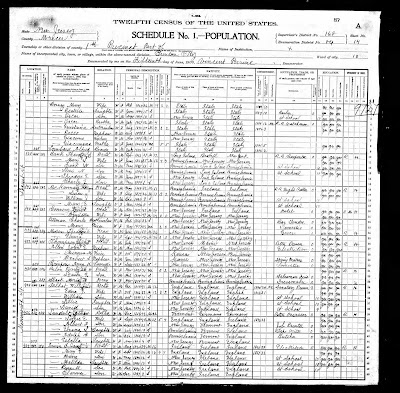
When looking through the census records it can be a little startling to see the two numbers listed a few columns over from the mother’s name. These columns stick to the factual… number of children followed by number of surviving children. The census is a form full of facts and numbers and doesn’t provide any additional insights as to the discrepancy. Seeing these do, usually different, figures has become routine for many of us conducting research on our families. However, when we dig a little deeper, when we find a name, that column is no longer filled with simple numbers. Below are just a few of the names that I have been able to find…

  • I knew about my great aunt Frances Reba Teaford from the time I initially became interested in the family history. A few of her siblings are still around and have shared stories about her with me and the short life that she lived. Frances was born in Eagle Rock, Virginia to Harry Gilmore Teaford and Nettie Love in 1926. She succumb to the ravages of Tuberculosis a few years after the family moved to Pennsylvania in 1943. However, I didn’t find out until later about a baby brother that was born in August 1930. Unfortunately, he passed away three months later still without having been given a name.
  • Samuel Ardis and Sarah Myers had three children together including twins born on April 18, 1902. Thomas died in July 1902 (a month before his father) and Edna died in March 1903 (seven months after her father).
  • My great great grandmother, Susan Laura Corner, was one of nine children born to Jacob Corner and Tamise Culp. However, by the time she turned five year old, she had already lost three of her siblings including her twin sister. Calvin was born two decades before my grandmother and never made it to his first birthday. Hannah was six when her baby twin sisters were born but only knew them for five years. Emma Flora, Susan’s twin, was just over two years old when she passed away.  
  • William McKannan and Susan Corner had three children, two sons and a daughter. Their youngest son, Reuben (named after Susan’s brother), was born in July of 1893. He was laid to rest in what would become the family plot in May of 1897.
  • By the end of 1919, William Jacob McKannan (Reuben’s brother) and Helen Fulton had four children, two boys and two girls. By the close of 1922, William was a widower caring for two sons. His two daughters, Marion (1916-1920) and Helen (1919-1922), both preceded their mother in death. Helen succumbed to a stroke on September 7, 1922.  
  • Over the course of a single year from 1879-1880, John Uttley lost both his first wife Sallie, who passed away in January 1880, as well as their only child Charlotte who was born in February 1879 and died three months later.
  • Jacob Wirth and Mary Eppright had four children. By August of 1864, Mary was a single mother of one. Their oldest daughter, Emma, didn’t even make it to her first birthday passing away at 10 months old in October 1858. The day following her father’s death aboard the USS Tecumseh at the Battle of Mobile Bay, Laura died just over a month shy of her second birthday on August 6, 1864 and Mary succumb to her illness (likely yellow fever) three days after her sister on August 9th.
Genealogy is about ensuring that the family history is passed down to future generations. Sometimes those facts and events are obvious and quite well known, other times it takes some digging to ensure that we have as complete a picture as possible. As many of you know, it is usually about the tiny details. Sometimes, even just ensuring that the name of a lost child it remembered is the greatest thing that we can accomplish. This is why I continue to try to make the connections and put the pieces together to tell the larger story but take the time to make sure that these children are part of the story and not forgotten. After all, each life is part of the family.