Showing posts with label handwriting. Show all posts

Sunday, July 24, 2016

Sunday Search: Documentation For My Supplemental Application


Ever since I received the letter from the Sons of the American Revolution saying that my application was accepted (actually, our applications), I have been working on my first supplemental application. As I have previously outlined, the first application was tracing back the Redcross line on my dad’s side of the family and now I am weaving my way through my mom’s side. It should be no surprise that the line that I am using for this application is tracing back to John Noblit.  

In addition to the previous difficulties tracing what was a line unbeknownst to us until recently, there was also the task of pulling together some of the documentation for recent generations. Surprisingly, there has been a lot of material uncovered and some tremendous recourses discovered which leaves little doubt about the family line prior to the 1940’s. Not including myself, the recent work has been in pulling together the documentation for the recent generations. Just last weekend, I finally got those last few items that I need to complete my second mountain of paperwork.

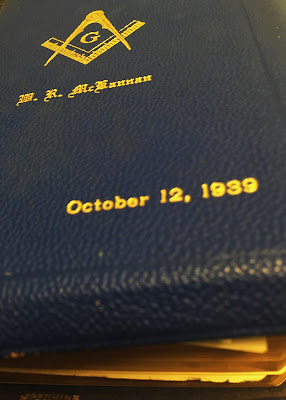
I have known about my grandfather’s Masonic Bible for most of my life and I knew that my grandmother would pull it out every once in a while not necessarily for what was written on the pages but to remember the family members represented by the scraps of paper between the pages. That being said, I had never taken the opportunity to sit down with my grandmother or my mom to really see what was contained within the blue covers. When my mom gave the Bible to me last weekend, I couldn’t help by start paging through the chapters and examining the documents that continue to buckle the cover.


There were certainly some interesting pieces of paper floating loosely between the pages containing names, marriages, birth and death dates, and some clippings from others moments in my grandmothers life including a photo from the local paper and a small clipping announcing a party for my grandparents’ 25th wedding anniversary. Of course, bound deep within the pages of the book is something that I had been looking for… my grandparents’ wedding certificate from 1940. In the subsequent pages I found not only the births of my mom and her siblings in my grandmother’s handwriting but also some of the deaths in the family from the time they were married through the passing of my uncles.

It is a unique opportunity to use this family record in my most recent SAR application and it is also an honor to be entrusted with the history contained in its pages. It is not only a connection to my family history as a whole but a real, tactile, connection to my grandmother and my grandfather. In both regards, I consider myself a caretaker of the family history and I hope to preserve not just the pages that have been passed down but also the documents that have been discovered over the years so that we are never again in a position to forget. 

Sunday, February 7, 2016

Sunday Search: Translation Please!


While conducting searches on different family members there is a variety of information that comes up usually requiring a lot of sorting, deciphering of handwriting, and frustration when the document that really piques my interest is in another language. More often than not I am at least able to figure things out not because I am fluent in multiple languages (I haven’t even mastered one) but because I know the basic format of what I am looking at. This hasn’t always been the case but after you have been doing the same kind of research for a while you generally know what information goes where largely based on where you find the name you are looking for in the document.

Early on in my research, these were pure moments of frustration that usually had me clicking on the ignore button before giving the document half of a chance to reveal itself. Now I find myself revisiting the branches on my tree and sorting through those forgotten hints so that I can again sort through them to see if anything is relevant to my family tree. I guess you could say that this is the curse of the world explorer membership on Ancestry.com.

However, this is only on instance where the language barrier can prove difficult or just flat out frustrating. While Google translate and similar programs are wonderful tools they are generally only reliable when it is strait text on a website. Add in the calligraphy element as well as the fact that most of these documents are in PDF or some other unsearchable file format and there is little that Google can do to assist. And I actually ran into this issue when researching my great grandfathers World War One unit.

When looking for information on the Motor Transportation Corps on the internet there is actually a limited amount of information that can be found as it pertains to the WWI incarnation of those units. When digging even further and specifying Unit 301, there is even less information available. After exhausting the limited resources that populated the first few search pages, I came across a PDF document of an account from one of the locals in France… you guessed it, the document is in French. Unfortunately, I understand very little of this language anymore having forgotten nearly all that I was taught in school and Google translate refused to assist in this matter.

Thankfully it is a typed account and a common language. Older documents found in dusty books are proving to be much more difficult. However, many are in the formats of which I am familiar and have provided me with a wealth of knowledge that has been added to my ever expanding genealogical database. But, and I will leave you with this thought, it would be nice to have the ability to instantly translate the material and I encourage researchers to know at least one other language and have a network of researchers who know a variety of other languages as well. You never know when your knowledge or theirs will benefit your research.

Sunday, January 10, 2016

Sunday Search: Familiar Faces


When my mom and I were looking through some of the family photos last weekend there were a number of times when we could easily see some other family members in the faces of the ancestors who have long since left us. And it was interesting as to when it would hit us as there was really no guarantee whether the person’s name or the current counterpart would be thought of first. At the same time, there wasn’t any certainty as to which one of us would make the connection either.

In some instances my mom would tell me who someone was in the photo and then follow up with something along the lines of “I didn’t realize how much your cousin looks like her.” There were other times when I would see either an aunt, uncle, or cousin in one of the people and as soon as my mom told me who they were it made complete sense. And, of course, there were various combinations of this throughout our time with the album on the table in front of us.

While it is certainly clear to those who know my family, I get much of my looks from my father’s side of the family. However, in looking through the photos with my mom I could see a little piece of myself in some of the pictures. I noticed a couple of little things like my hair line and posture but what really stood out to me, which I knew of before, was the handwriting that was on the backs of many of the photos. While my looks may be predominantly from my dad’s side, my handwriting is, without question, from my mom’s side.

Sometimes these ties are really what make looking through old photos in particular so interesting. On the surface you are putting faces to names but on a completely different level you are finding yourself and many of your other family members in little pieces of the past. It just goes to show that your family, your whole tree, plays a big role in who you are regardless of what you might think. This, of course, is in addition to the obvious genetic traits that we carry. Sometimes it is in the simple things like looks but sometimes it can be in other ways like handwriting, the way you hold yourself, and your demeanor.

For better or worse, I kind of have a mix of all those things. There are little pieces from both sides that I carry with me every day. And I am certain that there are many other similarities that I have yet to discover with some of my ancestors. So you can look at genealogy as pulling together the family history or you can look at it as finding pieces of yourself. For me, it is definitely a little of both.

Sunday, January 3, 2016

Sunday Search: Putting Names To Faces


When my wife and I were figuring out our schedule for the weekend we knew that we wanted to get together with my parents before they left for a little warm weather vacation next week. Fortunately, despite some other changes to our plans, everything worked out and we spend yesterday afternoon together. More importantly, our son spent some time with his grandparents.

It was supposed to be one of our usual get togethers over lunch and then back at the house to catch up on things (even though I talk with them every few days). It is a nice relaxing time. However, I decided to change things up a bit yesterday when, because the thought popped into my head, I decided to pull out the photo album sent to me months ago (maybe over a year at this point) and flip through the pages with my mom. We did a quick scan before lunch noting some of the relatives I knew, many that I didn’t, and, oddly, some that I recognized but my mom didn’t.

This was a long overdue project and after lunch, toward the middle of the afternoon, we revisited the photos but this time we took a closer look and I had post it notes in hand to record the names. After flipping through a few of the pages and not being able to put a name to a face on a few occasions, we peeled back the plastic and carefully pulled up the pictures from the paper in the hope that there might be some information on the back. While this didn’t always work, there were a few times when it did and it allowed us to put a few more pieces together.

What we couldn’t figure out immediately was the handwriting on the backs of the photos until one of the last pictures had the simple words inscribed on it “My Mother” which means that my grandfather labeled many of the photos that we had been looking at over 30 years ago. It was one of those things that we didn’t expect but glad that we figured out. What was also nice was the fact that I have done so much on the family tree because there were a few times when only first names were known or ‘that was her or his daughter.” By having much of the tree completed, I can write down the bits of information now and put the pieces together later.

Hopefully, this is the first of many times when I can sit down with my mom and put faces to names. There are a number of other loose photos and albums stored in drawers at their house and I am eager to flip through them and finally pull together a visual history of the family in addition to the information that we already have. Who knows, maybe I can even discover something new. But, for now, it is back to the current album where I can now write (with an archival pen of course) on the backs of the photos the names of the faces on the front.   

Friday, July 11, 2014

A Conference Room Full Of Random Thoughts


For much of this past week I have been in and out of meetings at all different times of day and every imaginable length. Given the time of year it really isn’t a surprise to have these kinds of days. The summer months are a time for planning and strategy in addition to our usual ongoing efforts. However, it is during these long sessions in the conference room when the conversations tend to veer off course.

One of the common culprits is a when a simple reference is made and only half of those in the room know the origin of the term or word. It’s like when someone knocks on the door and says “Land shark” or “Candy gram” there are going to be people with grins and others with blank stares. This inevitably turns the discussion into a back and forth about what we remember growing up and what may have been missed by some.

It is fascinating how much you can relate to your colleagues just by recalling random memories from childhood and during the early parts of your life. Not the major events just the small moments, songs, television shows, movies, and the other things that passed by without us giving them a second thought. Even the way that certain streets used to look or department stores that we used to visit. These are the conversations that make me wonder if I have really gotten to that point in life when we look back and wonder how things have changed so much.

Of course, what doesn’t help in this self-evaluation is the fact that I rarely get references to current pop culture and I frequently find myself giving directions according to old stores and landmarks. Heck, I still prefer writing notes by hand, reading paper copies of books and documents, and paying by check. And, what really throws off my oldest niece, I still text in complete sentences with all the words spelled out… I don’t know if that is more my age, a little OCD, or both.

In the end, time moves forward, life happens, and changes occur. All we can do is keep our perspective and appreciate all that we have seen and done… everything it a memory. While we can see, feel, and sense our memories that is all that they are. It is interesting how those present events can awaken the thoughts of the past merging the two into a new experience that makes you wonder how old you really are. It makes you think about how long it will take before you look back at today in the same way that you look back to memories from childhood. Is that even possible? I guess we will have to wait and find out.


Thursday, August 22, 2013

One If By Hand, Two If By PC


(L-R) Guest Speaker Dr. Beverly Moskowitz and President Elect Sean M. Teaford

Most people don’t give much thought to the legibility of their own handwriting. Poor penmanship is something that we tend to only notice when we have to read a note, a form, or, all too often for some, a prescription. But on a day to day basis we really don’t think about this.

As I have said before, one of the wonderful aspects of Rotary is meeting people and hearing speakers who introduce concepts and ideas that we wouldn’t normally give significant consideration in our everyday lives. The importance of handwriting and the legibility thereof is something that Dr. Beverly Moskowitz has dedicated her life to for the majority of her 37 years of experience as a pediatric Occupational Therapist. In 2011, she authored the largest research study ever conducted with the primary focus placed on handwriting with her program proven to be 99.9% effective in the classroom.

During our meeting she shared with us the evidence generated from that study of why handwriting instruction still matters and how learning institutions can embed effective, efficient, measurable and fun manuscript instruction into the school day. The results, to say the least, are staggering and the need for further instruction in this simple fine motor skill is one that not only provides the basic benefit of clear written communication but it has a much longer lasting impact on the functionality and effectiveness of the written word which students carry with them throughout their lives. The ability to formulate concise thoughts and articulate them efficiently and effectively is rooted in the fundamentals of putting the tip of the pen or pencil on the paper.

This breakthrough is a result of Dr. Moskowitz’s extensive real world experience as a school therapist where she has serviced more than fifteen school districts and over 60 different schools. Her broad exposure to a variety of teaching methods, administrative styles, and treatment interventions has confirmed her resolve to insure function, participation and inclusion for all students without wasting time. The result of this lifetime of experience in conjunction with her creative background has been a body of intellectual property and products that reflect current educational policy, practices and problems alongside the latest evidence and curricular demands.

In 2010, after spending years in the field as well as authoring numerous publications (including Practical Strategies for Increasing the Effectiveness, Efficiency, and Impact of your School-Based Occupational Therapy Practice) and lecturing across the country through the Bureau of Education and Research, Dr. Moskowitz launched Real OT Solutions, Inc. The company’s mission, as both a service and product-oriented business is to provide consumers (therapists, teachers, parents and kids) with Effective, Efficient, Affordable and Fun solutions. Guided by evidence and literature on best practices regarding optimum function, independence and accessibility, they create tools to make kids successful, documentation fast, teachers cooperative, and parents satisfied.

I personally have little background in the field of education beyond my participation as a student and a few stints as a teaching assistant. However, I have spent the majority of my life putting pen to page which has made me who I am today. I know for a fact that the inability to accomplish this simple task is something that has a detrimental effect on the creative, processing, and overall mental abilities of an individual.

This is, in large part, why the annual survey results of incoming college freshmen outlined in the Beloit College Mindset List because in 2010 it was revealed that the majority, and a large one at that, of incoming students didn’t know how to write in cursive. My immediate thought is that if you can’t write cursive how do you expect to read, or more accurately put decipher, something written in the hand of someone else? It just goes to show that history is not the only thing that is lost on much of the younger generations. How long before they forget the name Paul Revere (we have already forgotten Israel Bissell)? After all, kids can’t even read anything written in his hand anyway.  

In the end this is not just a generational disconnect but also a modern social division as well. On a screen everyone seems equal but when you put pens in people’s hands there is an erosion of both confidence and the ability to communicate as well as clear evidence of the degradation that exists in the school systems. Confidence in writing breeds confidence in thought and communication. Effective communication is the great equalizer so if you want to achieve true equality in the schools you much make sure that all students can communicate.