Showing posts with label Redcross. Show all posts

Sunday, July 3, 2016

Sunday Search: Tracing Back To Yorktown


My Sons of the American Revolution application begins with a very concise statement which reads:

“I hereby apply for membership in this Society by the right of bloodline decent from John Redcross [my 5th great grandfather] who assisted in establishing American Independence while acting in the capacity of private in the Amherst County (Virginia) Militia in 1781 under Major Cabell, Colonels Gaines and Pope.”

While this is certainly true, and has been verified as such, it only tells a portion of the story about my ancestor.

John Redcross was born in Amherst County, Virginia in 1740 as a member of the Monacan Indian Nation. While there is little known of about his early life we do know that while we know he was one of many Monacan men who served during the Revolutionary War beginning his service in February 1779 as a member of Captain William Long’s Company of the 2nd Virginia State Regiment commanded by Colonel William Brent. He served in this infantry unit likely until the spring of 1780 when most of the regiment was discharged. However, there is the possibility that he remained in the regiment and was reassigned to the Amherst County Militia under Major Cabell as both the 2nd Virginia State Regiment and the Amherst County Militia participated in the Siege of Yorktown and were present at Cornwallis’ surrender.

It is also noted in the book Strangers in Their Midst: The Free Black Population of Amherst County Virginia that “In 1781 he [Rawley Pinn], John Redcross, and Benjamin Evans were part of the 2nd Virginia Cavalry and left Amherst on June 21, 1781 under the command of Maj. William Cabell, Jr. Between Amherst and Yorktown, they joined the troops of the Marquis de Lafayette, and all participated in the siege at Yorktown.” It is fascinating to think about this unique band of brothers, bound together by heritage, by race, and patriotism, fighting for the freedom that their families would be deprived of for almost another two hundred years.

While the link to his previous service is something that still comes with a few questions, and despite the lack of acknowledgement in the history books, what is certain is the role that he played at Yorktown as his name can be found written in the hand of Colonel Daniel Gaines in his list of “Militia ordered into service from Amherst County… March to join the army commanded by the Honorable Major General Marquis de Lafayette, June 21, 1781” as well as the list of soldiers from Amherst County who served at the Siege of Yorktown published in the Lynchburg News on Thursday, May 22, 1884.

Officially discharged on April 25, 1783, John Redcross returned to Amherst County where he would continue raising his family until his death in 1800. And while there have been many instances when the family origins have been questioned, namely the registration as “mulatto” and as “free black” in the mid-19th century, the attempted revision of ancestral history by Walter Plecker in the early 20th century, and the ongoing surname associations with the Cherokee, the Redcross name is of Monacan, and therefore Sioux origin. In the aforementioned Strangers in Their Midst: The Free Black Population of Amherst County Virginia, the author writes the following while referencing Peter Houck’s book Indian Island in Amherst County,

“John Redcross (circa 1770-1861) is considered a second founder of the settlement. In 1783, his father (also John) was shown with 11 whites in his household, but Houck believes that the son and namesake “was probably the only pure-blooded Indian man in the original settlement” [page 66]… Redcross has been described as Cherokee, but the evidence does not support that, leading to speculation that he may have been Monacan or at least Siouan. John’s son Paul was said to have looked like his father, “… every inch an Indian… straight as an arrow, long haired, with high cheek bones and copper skin.”

This is a particularly interesting passage for my family as it follows three generations from which we are descendants.

While this lineage may have been lost to my family for decades, it is now a living part of who we are and has proven to be a valuable connection to our family’s history and participation in the Revolutionary War. This is a part of our family history that will never again be forgotten. And now, the next time we visit the Monacan Burial Ground on Bear Mountain, we can pay our respects not just to our ancestor but to man who fought for our freedom.

Sunday, June 26, 2016

Sunday Search: Membership Approved!


On June 17th my family, being descendants of Private John Redcross who served in the Amherst County Militia, was officially approved for membership in the Sons of the American Revolution. The wait is finally over and years of genealogical research has now been verified. A lineage that was absent from our tree only a decade ago is now ingrained in our collective identity. An identity that now consists of Monacan blood and a history of patriotism that traces back to the founding of this country including our participation at the Battle of Yorktown (more about this story in a future post). There is no longer a question or beginning our statements with “I think” or “we believe”, now we can respond with certainty and clarity. Now we know.

This is the first of many applications that I will be submitting to verify various lines of my family history. In fact, I am nearing the end of completing my second application (first supplemental application) this time tracing back to Private John Noblit on my mother’s side of the family. Like the first, this is a lineage which we were unaware of until only a couple of years ago. With little information having been passed down in the family, much of what I have found over the last decade, including this discovery, was forgotten but now can no longer be considered lost.

While I am uncertain as to the order of subsequent applications there are many lines which I need to investigate further. Of the dozens and dozens of possibilities it will all come down to a simple process of proceeding with the one which holds the most promise and, more importantly, the most documentation. It will be a lifelong project that will never be “complete” and I am okay with that as each application, each patriotic line that is verified, strengthens the roots of our family tree.

There will be many applications that will be submitted but it is this approval that means the most. This is the first step to that lifelong process and is something that I am proud to pass down to my son. We are part of a greater history of this country and our family, like many others past and present, can now make the honest claim that we helped to form and shape this nation. This is the next step in our continued effort to strengthen our ties with our heritage which was started decades ago when those initial family lines were revealed to many of us. This is our history and we can never again allow it to be forgotten. This is an important part ensuring that we will always remember.

Sunday, June 5, 2016

Sunday Search: Other Genealogy Groups

More piles of paperwork like this one should be expected...  
While I should hear back soon, I am still waiting to hear back from the Sons of the American Revolution regarding my application tracing back to John Redcross. As this process continues, I am looking into a variety of other genealogy, specifically hereditary and lineage based, organizations. The first group consists of those closely tied with the current outstanding application and the supporting documentation already compiled. This should streamline my application for the Sons of the Revolution. And while currently under consideration through a different line, it is possible that I may submit an additional application tracing back to John Redcross to the Monacan Indian Nation… we just need to find that one additional document!

Of course, while compiling the other supplemental applications to these aforementioned organizations, there is the possibility that I could uncover additional information prior to the revolution or find ancestors who served as commissioned officers. In these instances I will be sure to process additional applications to the Order of the Founders and Patriots of America, the National Society Sons of the American Colonists, The Society of the Cincinnati, and the General Society of Colonial Wars. All of these organizations have varying genealogical requirements so there really is no guarantee that I will be able to successfully gain membership but I can always try so long as I have the evidence to support my claim.

Given the broad history that we have uncovered in my family, on both sides, it is interesting to see where I can submit applications for membership. After all, not all lines can be traced back to the Revolution, or involvement thereof, so it is quite useful to have a number of other organizations to join for not only the purpose of enjoying the company of others with a common family history but also as a means to confirm and verify the research and genealogy work that we have done. Depending on the family line, there are a variety of other organizations for which I have already pulled together the necessary documentation which include the Society of the War of 1812 (Jacob Teaford), the Sons of Confederate Veterans (George William Clapsaddle), and the Sons of Union Veterans of the Civil War (Jacob Worth).

The only other organization that offers some certainty as to whether or not we will be able to gain recognition is the Genealogical Society of Pennsylvania which recognizes the First Families of Pennsylvania. This recognition is achieved by a “GSP member who can prove descent from a resident of what is now Pennsylvania” during one of the following time periods: Colony and Commonwealth: 1638–1790; Keystone and Cornerstone: 1791–1865; or, Pennsylvania Proud: 1866–1900. There are plenty of ancestral options on my mom’s side of the family and, surprisingly, a few possibilities on my dad’s side as well. These will, most likely, be submitted as I pull together information for some of the aforementioned organizations when there is an overlap in the genealogy.  

Those are the organizations where I have a certain level of confidence that I will, at one point or another, be submitting an application for membership. However, there are some other lines that I have been tracking which, while I have yet to fully document, could provide some additional opportunities to submit applications to the Military Order of the Stars and Bars (Confederate Officers), Aztec Club of 1847 (Mexican War), The Huguenot Society of America (French Huguenots), and the Saint Nicholas Society of the City of New York (ancestors living in New York prior to the Revolution). Again, I consider these the long shots but if the documentation is there I will gladly submit the applications.

Sunday, April 17, 2016

Sunday Search: Requesting Records

Excuse me, have you seen my family? 
A recent conversation with a brother from the lodge got me thinking a little about some of the organizations that I could possibly join in recognition of my ancestors. Namely those who participated in the Civil War both in the Union and Confederate armies. I know that there are plenty who fought on both sides and I even have a few of the records, mostly pension papers, for a number of people who participated in the conflict. That conversation also had me wondering about the lives and service of a few others in the family tree.

Early this week I decided to take action on these thoughts while also taking a chance that there is more information out there that still exists by submitting service record requests with the National Archives and Records Administration. The first form I filled out is also the most obvious. While I have been able to piece together some of the detail surrounding the death of Jacob Worth (1836-1864) during the Battle of Mobile Bay while serving at a First Class Fireman aboard the USS Tecumseh (Union), that is pretty much the limit of my knowledge. Anything regarding his service before that fateful day is a mystery and hopefully there is a service record available to provide some answers.

The second ancestor I submitted was George William Clapsaddle (1834-1916) who served as a Private in the 28th Regiment, Virginia Infantry, K Company (Confederate). The only details I have about this 3rd great grandfather’s service is in the regimental history and in his application for assistance from the Federal Government that he filed on 10 November 1902. According to records, he enlisted on 20 July 1861 (one day before the regiment’s participation in the First Battle of Bull Run (Battle of First Manassas) and mustered out on 30 September 1861. I am particularly curious read about his time at part of the 28th Virginia especially given his short length of service.

The request I made was for the service record of Jacob Teaford (1790-1877) who was part of Captain Joseph Larew’s Company of the 6th Regiment Virginia Militia. While there is little I have been able to find regarding his service during the War of 1812 beyond his basic pension listing, I did find that the 6th Regiment Virginia Militia did take part in the Battle of Baltimore in September of 1814 in support of Major George Armistead in defense of Fort McHenry. Obviously, I am curious to know whether my 4th great grandfather was present when Francis Scott Key was inspired to write what would later become the Star Spangled Banner.

The final file that I hope to receive is that of John Redcross (1740-1800) about whom I already have a mountain of information but still have a few holes that need to be filled with regard to his service. He served in Captain William Long’s Company, 2nd Virginia State Regiment, for nearly the entirety of the Revolutionary War including active participation under the command of Major General Lafayette and later as part of Colonel Charles Dabney’s band of regiments during the Siege of Yorktown. I am fascinated to see if any additional information is provided.

So those are the four requests that have been submitted. I am going to wait to see what is sent to me before submitting anymore but really any new information will be well worth the time, energy, and nominal fee. Of course, there are still other request that I have to make from other organizations but, being more recent records, there are a few more steps that I have to take. I guess I know what my next genealogy task will be. Stay tuned for results.

Sunday, April 3, 2016

Sunday Search: In Flight Questions


I am not someone who flies well. In fact, there have been many times when I have barely been able to open my eyes on the plane. It isn’t really the flying part that gets me it is the taking off and landing that doesn’t play well with my stomach. However, there have been moments from time to time when, for some reason, there hasn’t been even the slightest twinge of queasiness. Ever hopeful, I always have a project or two on hand when I fly with the hope that I will actually be able to remain productive during these unusual moments.

Today was kind of an in-between flight for me. While I was not in a position to start pulling out books and files or flip open my laptop, I was still able to think about some of the questions that still linger in the family tree. Keep in mind that these are topics that I keep on hand, jotted either on a post it note at my desk or, as was the case here, written as a note on my cell phone. Here are the questions that I keep coming back to hoping that I can think of a new angle or a new place to look:

  • Why can’t I find any record of Marcellias Nicholas Love prior to his marriage to Laura Belle Redcross in 1889?
  • Who was the third Jacob Teaford’s mother? Can this information be found in his service record from the War of 1812?
  • Where is the marriage certificate of Paulus Redcross and Frances Beverly?
  • When did the original William McKenna immigrate to the United States? Where did he enter?
  • Where are the records for Alexander Fulton? Any relation to the Fulton family in Lancaster County?
  • Why is there so little information on Mary Eppright? Is the family really tied to the Muhlenberg line?
  • Who is John W. Ardis’ father? Was he in the Revolutionary War?
  • Where can I find more information on the Yeagle and Corner families?
  • Who was John Uttley’s father? What did he do (his son and grandson became Philadelphia Police Officers)?
These are the questions that I am most eager to answer at this point in my research. This is why I keep this list with me nearly everywhere I go. It is a simple reminder that I am sure most genealogists keep on hand not just for when we are sitting among the stacks or at our laptop at home. Sometimes we just need to step away from the inundation of information and just think about the possibilities of where we might find the answers as well as mull over the many theories that we all have regarding our family mysteries. In the end, there are times when these undistracted moments can be the most fruitful. But, for now, for me, they remain questions.

Sunday, March 6, 2016

Sunday Search: SAR Update


During the latter part of this past January, I finally sat down and pulled together my application and supplementary material to submit to the local chapter of the Sons of the American Revolution. Since that time there have been many rounds of updates, revisions, and completing additional applications (and securing the appropriate documentation) for other family members. In all, five applications have now been submitted with more on the way once these initial memberships are approved. All of this work has been done while in direct contact with the state registrar who has been a tremendous asset throughout the process.

While it will still be approximately another two months before we hear back from the National Headquarters regarding our applications, I have remained quite busy during the wait pulling together the list of supplementary applications that I will be completing once my membership is approved. While this initial lineage is a line that is found on my father’s side, the next set of documents will be those from my mother’s side of the family. The hope is that I will have the information available to those family members who are interested in joining regardless of which side with whom I am speaking.

So, over the next year or two, I will be delving into the other lines that I have discovered thus far in my research. While there are many that I will be able to prove I am certain that there are some that are either incorrect or for which there is insufficient supporting documentation. However, I won’t find out until I am able to focus on each of the patriots below. While I am only confident about the first three I am sure that there will be endeavors that prove to be fruitful. So, here you go, this is the list of the patriots to whom I will be tracing my lineage:

  • John Noblit, Private, 7th Battalion, Chester County Militia; Suffered depredation.
  • Thomas Noblit, Private, Chester County Militia, survived Battles of Chadds Ford and Brandywine.
  • Jacob Duffordt, Virginia Patriotic Service, Provided supplies to the Continental Army
  • Peter Rough/Rauch, 2nd Battalion, Northampton County Pennsylvania Militia
  • John Snider/Snyder, Corporal, Flying Camp Maryland Militia; Wounded at White Plains.
  • George Michael Wilfong / Wildtfang, Virginia Patriotic Service, Paid Supply Tax
  • John Cook, Private, Logan County Virginia Militia
  • David Riggin, 2nd Delaware Regiment
  • Richard Payton Bailey, 15th Virginia Regiment
  • Robert Stinson, Massachusetts Patriotic Service, Committee to Produce Soldiers
  • George Clapsaddle, Franklin County Pennsylvania Militia
  • Johann David Von Nida, Virginia Patriotic Service, Paid Supply Tax
  • Frederick Boyer, Philadelphia County Militia
  • Thomas Brown, Private in Virginia Militia
  • John Beverly, North Carolina Patriotic Service, Paid For Services
  • William Terry, 3rd and 5th Virginia regiments
  • Jacob Gery, 6th Battalion, Philadelphia County Militia
  • John Philip Mumbauer, Private, Bucks County Pennsylvania Infantry
  • Johann Andreas Dressler (Andrew Tressler), 2nd Battalion, Berks County Militia
  • Johan Heinrich (Henry) Myers, 5th Battalion, Lancaster County Pennsylvania Militia
  • John Philip Negley, Private in Gray’s Pennsylvania Regiment
  • John Norbeck, 1st Battalion, Berks County Pennsylvania Militia
  • John Phillip Young, 6th Battalion, Philadelphia County Militia
  • Rufus Cone, 7th and 17th Connecticut Regiments; Taken prisoner at the Battle of Long Island; Died aboard the prison ship off the coast.  
  • George Philip Royer, 4th Battalion, Philadelphia County Militia
  • George Walker, Cumberland County Pennsylvania Militia
  • Matthias Kerlin, Pennsylvania Patriotic Service, Paid Supply Tax
  • John Sheaff, Private, 6th Battalion, Chester County Pennsylvania Militia
  • Frederick Augustus Muhlenberg, Pennsylvania Patriotic Service, Representative to Continental Congress
  • Henry Melchoir Muhlenberg, Pennsylvania Patriotic Service, Patriot Minister
If you add in the application already submitted tracing back to John Redcross that makes for 31 ancestors that I will be researching. In addition to the history interest and family history that will certainly be uncovered during this endeavor, there is also a much more practical reason for not settling and submitting as many supplementary applications as I possibly can… verification. Many of the aforementioned names are recent discoveries and while there are many lines which I am confident that they are correct, there are some where the generational connections are tenuous at best.

However, overall, by submitting each of these lines and the supporting documents, I am able to have the research certified by and independent third party, the Sons of the American Revolution. In those instances where they are able to verify my findings, the family history just got that much stronger. All of the sudden, those branches which have been withering for decades, are once again vibrant and proving to be some of the more colorful contributors to the family foliage. And, just think, we will be able to pass this down to future generations and nearly ensure that our family history is not forgotten.

Sunday, January 31, 2016

Sunday Search: SAR Update


As many of you may recall reading, I have been trying to find the time over the past few years to finally sit down, pull together all the documents, and submit my application to the local chapter of the Sons of the American Revolution. Of course, up until last week I hadn’t even reached out to the SAR to get additional information so that was the first step that I had to take. So, out of the blue, I looked up the local contact information and gave the chapter a call. After a very nice, informative, and welcoming conversation I received some sound advice as to how I should proceed the most important of which was to start with the ancestor that I can most easily prove.

My goal when I made the call was to get everything pulled together over the next several weeks, two weeks if I was lucky. This seemed to be an agreeable and manageable arrangement for both of us and I was encouraged to attend meetings in the meantime while I was finishing up my application. By the time we ended our conversation I already knew which ancestor made the most sense. While the documents that I have in my possession are not enough for the Monacan Indian Nation, they are more than enough prove to the SAR that I am a descendant of John Redcross.

Well, somehow I finally found the time to get it done and I was able to submit all 200+ pages to the local chapter for review. This past week has been a time to review the application that I submitted and, surprisingly, a time for the chapter genealogist to condense the documentation down to only the items needed. We really do have more than enough to prove our lineage and, at the same time, not enough. Now we can focus on finding that final piece so that we can submit the same material to the Monacan Nation.

It is a great feeling knowing that this is done and that after this it will be a matter of adding confirmed patriots to the family history. Heeding the advice of the SAR, now I am going to move to the next easiest to prove which happens to be on the other side of my family. While we once thought it impossible, I have been able to trace back my mom’s side to the Revolution as well and have the documentation to support the findings as well. It is nice to know that basically no matter which family member I am talking to I can help them join the SAR (or DAR).

However, the most important aspect to this whole process for me is that it is a means to verify the research that I have spent the last few years conducting. The more lines I can confirm and revolutionary ancestors I can trace back to, the more information in our tree I will be able to verify. Having had so many questions about the family history growing up, I am looking forward to sharing with the family a history that has been not only researched by certified as being accurate. And, one day, I look forward to sharing this history with my son.

Sunday, October 25, 2015

Sunday Search: Lost Children


One of the things that many people overlook about genealogy is the fact that it is not always about making the remarkable link to some historical figure or event. Sometimes it is about making sure that people are not forgotten. This doesn’t just apply to those names that may not be part of the usual family discussions, it is about the names that may not have even carried over to the next generation. I have written about many of the people that lived interesting lives, some that may have died too soon, and others whom I simply wanted to learn more about. To date, the list is rather extensive and includes the following leaves from my tree:

Those are just a few of the lives that I have tried to bring back to the forefront of my family history. Many of the details were already known to various family members but there have been a few that have come as a surprise (at least some of the details). These stories are fascinating to me and I will certainly be adding to that list in the near future but, for now, I wanted to take the time to share some of the names that can too easily be forgotten. Some lives are cut short while other lives never had a chance to get started.

When looking through the census records it can be a little startling to see the two numbers listed a few columns over from the mother’s name. These columns stick to the factual… number of children followed by number of surviving children. The census is a form full of facts and numbers and doesn’t provide any additional insights as to the discrepancy. Seeing these do, usually different, figures has become routine for many of us conducting research on our families. However, when we dig a little deeper, when we find a name, that column is no longer filled with simple numbers. Below are just a few of the names that I have been able to find…

  • I knew about my great aunt Frances Reba Teaford from the time I initially became interested in the family history. A few of her siblings are still around and have shared stories about her with me and the short life that she lived. Frances was born in Eagle Rock, Virginia to Harry Gilmore Teaford and Nettie Love in 1926. She succumb to the ravages of Tuberculosis a few years after the family moved to Pennsylvania in 1943. However, I didn’t find out until later about a baby brother that was born in August 1930. Unfortunately, he passed away three months later still without having been given a name.
  • Samuel Ardis and Sarah Myers had three children together including twins born on April 18, 1902. Thomas died in July 1902 (a month before his father) and Edna died in March 1903 (seven months after her father).
  • My great great grandmother, Susan Laura Corner, was one of nine children born to Jacob Corner and Tamise Culp. However, by the time she turned five year old, she had already lost three of her siblings including her twin sister. Calvin was born two decades before my grandmother and never made it to his first birthday. Hannah was six when her baby twin sisters were born but only knew them for five years. Emma Flora, Susan’s twin, was just over two years old when she passed away.  
  • William McKannan and Susan Corner had three children, two sons and a daughter. Their youngest son, Reuben (named after Susan’s brother), was born in July of 1893. He was laid to rest in what would become the family plot in May of 1897.
  • By the end of 1919, William Jacob McKannan (Reuben’s brother) and Helen Fulton had four children, two boys and two girls. By the close of 1922, William was a widower caring for two sons. His two daughters, Marion (1916-1920) and Helen (1919-1922), both preceded their mother in death. Helen succumbed to a stroke on September 7, 1922.  
  • Over the course of a single year from 1879-1880, John Uttley lost both his first wife Sallie, who passed away in January 1880, as well as their only child Charlotte who was born in February 1879 and died three months later.
  • Jacob Wirth and Mary Eppright had four children. By August of 1864, Mary was a single mother of one. Their oldest daughter, Emma, didn’t even make it to her first birthday passing away at 10 months old in October 1858. The day following her father’s death aboard the USS Tecumseh at the Battle of Mobile Bay, Laura died just over a month shy of her second birthday on August 6, 1864 and Mary succumb to her illness (likely yellow fever) three days after her sister on August 9th.
Genealogy is about ensuring that the family history is passed down to future generations. Sometimes those facts and events are obvious and quite well known, other times it takes some digging to ensure that we have as complete a picture as possible. As many of you know, it is usually about the tiny details. Sometimes, even just ensuring that the name of a lost child it remembered is the greatest thing that we can accomplish. This is why I continue to try to make the connections and put the pieces together to tell the larger story but take the time to make sure that these children are part of the story and not forgotten. After all, each life is part of the family.

Sunday, August 23, 2015

Sunday Search: Missing Documents


Over the past few months there have been moments when I have made surprising progress researching my family trees and there have also been instances when I have hit some pretty significant walls. No matter how hard I have tried to hit the brick or how heavy the hammer, the structure remains solid. While there is still some small glint of hope that these records will turn up, it is not an endeavor that will likely produce significant results anytime soon… I guess I will have to get the chisel out and try to find the answers that way.

After all, that is how I found the few details that we know about John Uttley’s service in the Philadelphia Police Department. After dozens of calls and many hours leveraging various resources I was able to find out that while the full personnel files have long since been destroyed, there are pieces (i.e. rank, badge number, date of swearing in, rank, accounts in the newspaper) scattered across multiple sources. It isn’t much but it is a heck of a lot more than we have had in the past. Other endeavors haven’t even produced this level of information.

My great grandparents (William Edgar Yeagle and Bessie Wirth Uttley) divorce is something that is still interpreted different ways depending on with whom you speak. His first family, which is my line, sees the dissolution of marriage in one way namely that it was his drinking and abuse that caused the divorce. However, his second family, according to his granddaughter with whom I briefly spoke a couple of years ago, sees things a little differently in that it was my great grandmother that caused the issues in the marriage. When I called the court records office in Philadelphia City Hall (where they got divorced), there was little information that they could share as the records have long since faded and the only information on hand was that of the actual decree (without mention of cause). But at least that record can be produced unlike some others.

The marriage certificate of Paulus Redcross and Frances Beverly continues to be one record that we are continuing to search for through various offices, depositories, and whatever other means out there. It is something that we know exists as it is recorded in the Amherst County, Virginia ledger but the actual document seems to have disappeared. Not faded or destroyed (as far as we know) it is just gone. No one has been able to provide any definitive explanation although there are plenty of theories out there which is a completely separate topic altogether.

All of these documents have the potential to provide my family with a wealth of information (and answers) beyond what the existing documents ever could but there is significant doubt as to whether we will ever be able to read them. While we will continue seeking answers to other questions and look to fill in the family tree, these are things that we will always be looking for even if the possibility of finding them is slim. While these situations may be a deterrent for some, it only serves to motivate me to find and write the story without them (or at least try).  

Sunday, July 26, 2015

Sunday Search: Virginia Discoveries


Not long after the reunion dinner started, those of us in attendance were presented with new genealogical information regarding our family history. This was a revelation to many of those in attendance and I was rather eager to see this new research that was being brought to our attention. Within the blue folder, in front of the directory of those in attendance that weekend, there were two pages (206-207) copied from Joan Wheeler LaGrone’s book “Chronicles of a Nation” detailing the history of the original family surname.

While many saw this as an expansion of the family tree, when I read through the short excerpt I realized it was more like a collection of leaves that had fallen to the ground. We know which tree they came from but we can’t be certain yet as to from which branch they fell. However, it is great information to have and while I was familiar with the New Jersey connection (they retained a surname that more closely resembles the original), I was unfamiliar with the history of the surname as well as the more recent Civil War era stories that were relayed in the book.

While that new information satisfied the curiosity of many, there were many other opportunities throughout the week that really provided additional color to the leaves on my tree. Many of these revelations occurred during a conversation I had with a Monacan woman at the living history exhibit at Natural Bridge. It was from this conversation that I learned of John Redcross’s participation at the Battle of Yorktown during the Revolutionary War. While I previously knew of his general service and the company to which he belonged, I was unfamiliar with his participation at this celebrated victory.

This conversation also put some pieces together for me as I found out that many Monacan families moved to Eagle Rock at the same time as my ancestors. I was always curious as to why they chose to move there and this provided me with a logical explanation… they were part of a group that moved rather than as an individual family. Finally, when discussing additional details regarding the documents needed to prove our ancestral claims, she provided additional guidance as to what documents to use and where we should look for other supporting information. Thankfully, we already have many of the documents that were discussed.

The following day, as has been recorded on this blog, we traveled to the Monacan Indian Museum in Amherst County. Once again, the woman there to greet us was warm, inviting, and seemed genuinely excited to discuss our pursuit of membership in the tribe. In addition to the advice that was generously bestowed upon us (and my Aunt a few days prior), I came across a book on display in one of the cabinets that offered a couple of pieces of missing information… the death dates for Preston Johns and his wife Louisa Terry (my third great grandmother – mother of Marcellias Nicholas Love).


With so much new information, advice, and connections made I am definitely looking forward to putting a few more pieces together as well as filling in the application I picked up for tribal membership. While this entire trip was a revelation of place, these moments were a revelation of knowledge. All of these things – people, places, events, information, connections, etc. – make up who we are and I am looking forward to retelling this story to everyone but most especially my son.

Sunday, July 19, 2015

Sunday Search: Virginia Cemeteries


A while back I drove around to the some of the local cemeteries to find some family members that have been forgotten as well as to visit some that we just hadn’t seen in a while. Actually, it was the first time that I can remember visiting any of them. It is with this trip still fresh in my mind (even two years later) that I decided to do the same thing, this time in Virginia.

The day after the reunion, we made our way to Eagle Rock and explored the place where my family once lived. After walking around the small town for a little while, we took my great uncle up on his offer to lead us to one of the cemeteries in the area. After a few turns down gravel roads…


…and a couple of stops to regroup and figure out where we were going we finally made it to Shiloh Cemetery. Here we found my three times great grandmother, Francis Redcross (Beverly) resting beside her son…


…as well as one of her daughters, Mary Jane Redcross (Duke), and her family just a few yards away.


Unfortunately, we are still unable to find my three times great grandfather, Paulus Redcross, who passed long before his wife.


After Shiloh we were on our own but fortunately, this time, knew exactly where we needed to go to find Forest Grove Baptist Church. When we arrived services were just coming to an end at the small church and, not surprisingly, we found a few relatives standing outside the doors talking amongst themselves. After a couple brief conversations, we headed back and began walking round finding that we were related to nearly every other person, in one way or another, throughout the cemetery.

In the back right of the granite field, under a large tree, we found my great great grandparents, Roy and Sallie (Clapsaddle) Teaford.


I have seen their headstones in pictures before but, as many of you know, it is a completely different experience seeing them with your own eyes. From this corner of the cemetery we slowly walked back toward the church until we found two more of my great great grandparents, Nicholas and Laura (Redcross) Love.


It was especially moving since now I have been able to visit, between all the cemeteries that I have visited, I have been able to visit four generations of my family. My grandparents and great grandparents in Pennsylvania and now my great great grandparents and great great great grandmother today. However, what struck me most about the day was when we turned around just before leaving and I was able to see all four great great grandparents in one peaceful picture.


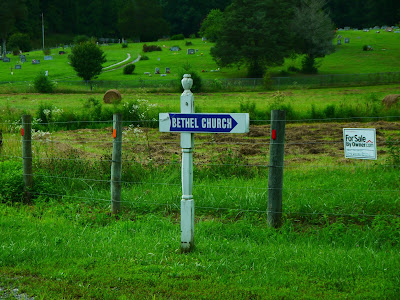
The following day, after our morning spelunking, we stopped by another cemetery in an attempt to find my great great grandfather’s first wife. After even more dirt and gravel roads than the previous day, we were finally able to find Bethel Church tucked back into the woods on a one way road.


The cemetery was just on the other side of the small creek where my dad and I walked up and down every aisle. In the end, much like Leverington Cemetery, we couldn’t find her name or family anywhere among the headstones that were still visible and legible.


This one is going to take some more work. Hopefully this time the church has some accurate records.

A couple of days later, as I previously wrote about, we visited the last cemetery of our trip while atop of Bear Mountain in Amherst County. While we were only able to find the names of a couple generations, I am certain that we were in the presence of many more generations at the Monacan Burial Ground. It took some effort, much more than the first time we visited a few cemeteries, but it was well worth the time, effort, and emotions. I am glad that we took the time to visit while in Virginia.

Wednesday, July 8, 2015

Sometimes You Can Feel A Place

 
The winding roads through the mountains and into Amherst County gave me the time to reflect on both all that we have seen thus far in our trip and also prepare for our next experience at the Monacan Indian Museum. I had called the museum during our drive through Lynchburg earlier in the morning so they knew that we were on our way… the most recent, as it turns out when looking at the sign in log, of a long list of family members that made the drive over the past week. Driving up to the small collection of buildings on Bear Mountain I could feel the connection with the place and the people there… it really is an indescribable feeling.

We were greeted warmly upon our arrival and after paying the modest admission fee we were shown to the next room where we watched a brief video about the history of our people. Given her recent passing, hearing Chief Sharon Bryant’s voice was both soothing knowing that her legacy lives on and also heartbreaking knowing all that she would have been able to accomplish if given more time. For those of you who have yet to view the video I have included it below and I encourage you to watch.


Upon the conclusion of the movie, we all got up and walked into the next room to learn as much as we could during our visit. Holding my son as I walked in, I was motivated even more to find the documents and information needed to become a member of the Monacan Nation. While looking around I was able to find a few more pieces of information for my research and I was able to speak with the woman who originally greeted us about what needed to be done (again, more about that later). Here are some of the pictured some the small but significant museum.


Even though the museum only consisted of three rooms we spent well over an hour looking around, talking, and learning about this part of our family history and heritage. After making sure it was okay to walk around and take pictures, we went next door to the Indian Mission School.
 
Given the years that it was used there is a good possibility that there were a few ancestors that received their education within those walls. It is amazing to think that the school was used until the 1960’s.
 

From within that small school house, one can look out the window and see the Episcopal Church just across a small creek.
 

A central part of the community, we walked over to the church to take a closer look…
 

…and when we turned the corner and approached the front entrance, a kaleidoscope of butterflies floated across the bridge laced clearing between the buildings…
 
…and converged on the flowering bushed in front of us.
 
As we walked away, the butterflies scattered into the wind. I am not usually one to think along these lines but I felt at that moment that was the way our ancestors were welcoming us back. It didn’t look or feel as though it was just a coincidence.  

Feeling both drained and energized, we got back in the car and drove up the road to another place I had only seen in pictures. Thankfully, we noticed the small sign along the side of the road and just a few minutes later I found myself standing in front of the final resting place for many of my ancestors. Within the lines of the single headstone at the front of the cemetery, many of my family surnames can be found… Redcross, Terry, Beverly, and Johns.
 
Behind this headstone are the graves marked with anonymous stones. All recognized as individuals but buried as a people.
 

It was the most moving part of the journey and gave me a lot to think about as we drove back through the mountains. Hopefully the next time I am able to visit will be as a member of the tribe and not just as a visitor.

Sunday, May 31, 2015

Sunday Search: New/Old Records On Ancestry

Birth Certificate of my great grandfather Harry Gilmore Teaford
While I would like to be on the site more often, I am only occasionally able to check Ancestry.com for updates to the various databases that are available online. Recently, I have had less time than usual to browse the site but was able to do so today. There are always new data sources and updates made but, especially lately, few have caught my attention like the ones I found today.

This past week, birth, marriage, and death records from Virginia were posted. While the date range is limited and they are by no means comprehensive collections, I was still able to find some new records as well as digital copies of records that I haven’t had the chance to upload. While the latter may not be new information, given the current disarray of my office, this was a welcomed discovery.

Death certificate of my great great grandfather Roy Harrison Teaford.
Death Certificate of my great great grandmother Sallie Clapsaddle. 
With these databases now available, I was able to explore a little more and find a few of the missing documents that I had been wanting to find including my great grandfathers birth certificate (albeit a registration from 1958), my great great grandfathers death certificate (I had found this information listed but was unable until now to find the actual record), the death certificate for my three times great grandfather, and the elusive Love and Redcross death certificates which I got copies of last summer but are sitting in a box next to my desk. It is interesting to go through these documents and confirm the parents (especially the mother’s surname)… I really didn’t expect to see Nicholas’ mother listed as a Terry. However, what was particularly striking was the fact that Laura and Nicholas Love’s death certificates were only a number apart from one another with them passing away only days apart from influenza (with some other contributing factors). It was just sad to see Nicholas listed as a widower when you know that Laura died only a few days prior.

Death certificate from March 9, 1939 of my great great grandmother Laura Redcross. 
Death certificate from March 16, 1939 of my great great grandfather Nicholas Love. 
Just like when the Pennsylvania records became available, I keep searching my family tree to find those that fit into the time frame. There are a few that I have been unable to find as the rural records are a little slower when it comes to digitization and there are also the ancestors who died just before the time frame of data available. Those are usually the ones that the parents’ names need to be confirmed. Also an interesting means of confirmation with these documents is that it tells you not only where they have been buried but also who the informant was at the time of death or who witnessed the birth as in the case of my great grandfather.

Death certificate of my 3x great grandfather George W. Clapsaddle.
Such is the ebb and flow of ancestry when the new sources are added followed by an extended wait and then more databases are added that are pertinent to your family research. In between is the time for digging, organizing, and finding all the more obscure sources and documents which are usually still exclusively in the physical (not digital) world. It is this back and forth multi-source process that continue to provide the results. Of course, Ancestry DNA should provide for some interesting insights as well but that is for a future post (when I get the results).