Showing posts with label Revolutionary War. Show all posts

Sunday, August 28, 2016

Sunday Search: A Local Family Reunion


In recent years I have gained a greater appreciation for our annual family gatherings. While it was a little different this year with regard to both place and time of year, it was still a great time catching up and simply seeing everyone in one place. Yesterday we gathered together and took the opportunity to talk and, more importantly, to listen about all that was going on in the family and all the unique experiences that each of us has had over the past year (and a half). It is interesting because we are actually quite the diverse group.

This year I was able to bring more than food to the ‘reunion’ as I had recently completed pulling together all of the information needed for my supplemental Sons of the American Revolution application. Thankfully, I was able to print out an extra copy before leaving the office on Friday which allowed me to go page by page, generation by generation, when explaining our patriotic lineage. This is another part of the process that I really enjoy as I could see their faces when I was able to uncover each piece of information and name of which they were previously unaware. It was the same look that I had when I originally discovered the information.

However, that was only secondary as it was family time to both talk about our lives and also remember some of the past times when we all got together for a day or two. This is the most important part and I have become more aware and appreciative of this particular aspect. After all, we can talk about the past and ancestors whose lives have long since been completed but it is the current, ever changing, lives that we lead which are what makes our family dynamic. Events such as this allow us to enjoy both sides of the equation.

While we all lead very different lives with different experiences, professions, and opinions, we are all part of one family with a common ancestry. Different branches, different leaves; same trunk, same tree. We live in the present but are always cognizant and respectful of the past. I enjoy sharing what I know, what I have been able to uncover, but I truly enjoy hearing about the family history and simply listening to the stories from the current generations. After all, documents will (usually) always exist but the stories will not always be told and are often lost amongst the generations. And a reunion is a perfect opportunity to listen.

Sunday, August 7, 2016

Sunday Search: Finding French Royalty


At this point in the process, the family tree has been well documented and we know a lot more than we did just a few years ago. We can trace most of our lines back through the decades and centuries deep into the 19th and 18th centuries in America. However, making the leap into the countries of our heritage has been extremely difficult. While we know the places from which our families emigrated, that is pretty much were our history ends. However, there are now a few exceptions to that pattern the most prominent and well documented of which is that of the Noblit line.

You may recall previously reading about John Noblit’s service during the Revolutionary War but the family history does back much further. Not only do we have a wealth of information, thanks in large part to Quaker record keeping at the time, about his father’s life, William Noblit, but the entire family that came to the colonies in the 1720’s from Ireland. And this is only the beginning of the pre-immigration journey. As it turns out, Ireland was only a brief stop in the journey to the colonies when looking at the family history in its entirety.

Prior to the family’s brief time in Ireland, only lasting a generation or two, the Noblit name is traced back to England where the family lived for a similar duration than that in Ireland. At this point, the truly exciting leap takes place when we venture into France. It is here that we find the most documents related to the family, their place in society, and their subsequent expulsion in the late-16th century. Yes, we are, by definition, Huguenots. These records don’t just cover a brief period of time, there are actually mentions of the Noblit/Noblet surname in documents dating back to the 12th century.

While the earliest mentions are scarce but beginning in the 16th century there are volumes of documents that have been found. What is especially fascinating, and tremendously useful, when tracing our family back is that some of these documents are patents of nobility. While I can’t confidently trace back to the earliest of mentions in the annals of history, I can, with documentation, trace back well into the 16th century and can, with relative certainty, state the fact that we are descendants of French nobility. This was a surprise to me but one that I am eager to explore further. Who knows, maybe one day I will be able to stay at the old family homestead in the Anjou region of France.

Sunday, July 31, 2016

Sunday Search: Who’s Next?


With the first supplemental application nearly done it is time to start looking through the family tree to see which line I will be submitting next. Now that the “easy” ones have been documented, all of the other options are going to require some more work. That being said, now that I have traced one ancestor on my father’s side and one on my mother’s side, I can at least look at all possibilities without having to limit my options. With that in mind, I have to look and see what information I do have and how likely it will be to find the supporting documentation I need for the additional lines.

Looking back at the list I compiled in March, there are certain things that still need to be worked on for each of the ancestors listed. While we have already submitted documentation for the Redcross and Noblit lines, there are still twenty eight (28) other names on that list. However, from that list, I have at least narrowed the selection down to a few ancestors where the mysteries are minimal and acquiring the documentation is realistic pursuit given my limited time at the moment.  

Jacob Duffordt, Virginia Patriotic Service, Provided supplies to the Continental Army. We have the documentation of him paying the supply tax as well as, what I believe to be his service in one of the Flying Camps. Additionally, I have all marriage certificates and other documentation going back to his grandson, my 4th great grandfather Jacob Teaford, whom I wrote about in May regarding his service at Norfolk during the War of 1812. The issue with this line is that we aren’t 100% certain as to the identity of this Jacob’s mother. It is a mystery that the family has been working on for decades but I believe that I am making some headway.

This is likely the next supplemental application that I will be completing but there are other patriots in the family that I will be researching at the same time including:

  • Johann David Von Nida, Virginia Patriotic Service, Paid Supply Tax
  • Frederick Boyer, Philadelphia County Militia
  • John Snider/Snyder, Corporal, Flying Camp Maryland Militia; Wounded at White Plains.
  • George Michael Wilfong / Wildtfang, Virginia Patriotic Service, Paid Supply Tax
  • John Cook, Private, Logan County Virginia Militia
  • William Terry, 3rd and 5th Virginia regiments
  • John Philip Mumbauer, Private, Bucks County Pennsylvania Infantry
  • John Norbeck, 1st Battalion, Berks County Pennsylvania Militia
  • John Phillip Young, 6th Battalion, Philadelphia County Militia
  • Rufus Cone, 7th and 17th Connecticut Regiments; Taken prisoner at the Battle of Long Island; Died aboard the prison ship off the coast
  • Matthias Kerlin, Pennsylvania Patriotic Service, Paid Supply Tax
Again, all have their small gaps in the documentation but I am confident in tracing these names and we will eventually be able to verify them. The real question for me is whether we will be able to trace back through the Muhlenberg line as this requires my research on one generation to be supported through documentation as the maiden name is the one that I have traced. This will require a considerable amount of effort which is why it will be worked on in the future, after a number of other patriots have been proven. That being said, I welcome any information on the Muhlenberg family tree to get things started.

Sunday, July 24, 2016

Sunday Search: Documentation For My Supplemental Application


Ever since I received the letter from the Sons of the American Revolution saying that my application was accepted (actually, our applications), I have been working on my first supplemental application. As I have previously outlined, the first application was tracing back the Redcross line on my dad’s side of the family and now I am weaving my way through my mom’s side. It should be no surprise that the line that I am using for this application is tracing back to John Noblit.  

In addition to the previous difficulties tracing what was a line unbeknownst to us until recently, there was also the task of pulling together some of the documentation for recent generations. Surprisingly, there has been a lot of material uncovered and some tremendous recourses discovered which leaves little doubt about the family line prior to the 1940’s. Not including myself, the recent work has been in pulling together the documentation for the recent generations. Just last weekend, I finally got those last few items that I need to complete my second mountain of paperwork.

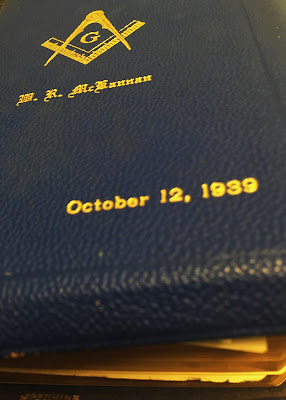
I have known about my grandfather’s Masonic Bible for most of my life and I knew that my grandmother would pull it out every once in a while not necessarily for what was written on the pages but to remember the family members represented by the scraps of paper between the pages. That being said, I had never taken the opportunity to sit down with my grandmother or my mom to really see what was contained within the blue covers. When my mom gave the Bible to me last weekend, I couldn’t help by start paging through the chapters and examining the documents that continue to buckle the cover.


There were certainly some interesting pieces of paper floating loosely between the pages containing names, marriages, birth and death dates, and some clippings from others moments in my grandmothers life including a photo from the local paper and a small clipping announcing a party for my grandparents’ 25th wedding anniversary. Of course, bound deep within the pages of the book is something that I had been looking for… my grandparents’ wedding certificate from 1940. In the subsequent pages I found not only the births of my mom and her siblings in my grandmother’s handwriting but also some of the deaths in the family from the time they were married through the passing of my uncles.

It is a unique opportunity to use this family record in my most recent SAR application and it is also an honor to be entrusted with the history contained in its pages. It is not only a connection to my family history as a whole but a real, tactile, connection to my grandmother and my grandfather. In both regards, I consider myself a caretaker of the family history and I hope to preserve not just the pages that have been passed down but also the documents that have been discovered over the years so that we are never again in a position to forget. 

Sunday, July 17, 2016

Sunday Search: Virginia Versus New Jersey


While searching through the pages and pages of Revolutionary War documents I happened to stumble across a very familiar name, Jacob Dufford. While we have been aware for some time of our immigrant ancestor providing supplies to the Continental Army on 17 December 1780, this document was completely different. This document which caught my attention was the “Names and ranks of those killed or taken on Long Island the 27th day August 1776.” The second name on that list, clearly printed, is Jacob Dufford. While an exciting find to be sure, it was quickly tempered, as I am familiar with the various Dufford families in the colonies at the time which begged the question, is this the same Jacob Dufford?

First, let’s consider the candidates…

Given the death of their original immigrant in 1767, the New Jersey line of the Dufford family has one possibility, Jacob Dufford from Morris County who was born in 1745 and died in 1822. Note that Morris County is immediate west of Northampton County, Pennsylvania. When conducting a further search into records, no other reference could be found regarding this Jacob Dufford and the Revolutionary War. In the Virginia Dufford tree, given the fact that the second generation Jacob was only 12 at the time, there really is only one possibility being that of our original immigrant, Jacob Dufford who was born in Alsace Lorraine on 12 January 1734, arrived in Philadelphia on 27 October 1764, and died in Augusta County on 12 April 1800. At the time, Augusta County extended well beyond its current boundaries all the way to Pennsylvania. Those are the two possibilities, the only two names that match.

Second, let’s consider the service document…   

The document which I discovered listed Jacob Dufford as having been killed or captured during the Battle of Long Island on the 27th day of August 1776. It also notes his enlistment date being 13 July 1776 and his discharge date being 1 December 1776 (the date on which the Flying Camps were disbanded). This information was confirmed when I was able to find his official service record. Despite his length of service being recorded as 1 month and 15 days, this second document, the only other document I could find and produced in November 1776 in Elizabethtown, provided me with some further details regarding the service of Jacob Dufford. As it turns out, he was a part of the Pennsylvania Infantry serving in Captain John Arndt’s Company of Colonel Baxter’s Battalion of Northampton County in the State of Pennsylvania of the Flying Camp… the Spartans of Long Island. While Baxter’s Batallion later fought at Fort Washington, it is doubtful that Jacob Dufford was present and/or able to fight as the prisoners taken by the British at Long Island were kept in inhumane conditions and nearly starved to death during their incarceration.

While this initial reading of the documentation suggests, based on county proximity, that this was a member of the New Jersey Duffords, I had to be sure and decided to look more closely into the history of the Flying Camps since I was unfamiliar with that term. Among the various writings on this obscure organization of militia forces during the Revolution, John Allen Miller’s article “The Flying Camp Batallion”, published on the Emmitsburg Area Historical Society webpage, proved to have the most complete history. In this article, Miller writes on the formation of the “Flying Camps”:

On June 3, 1776, the Continental Congress resolved "that a flying camp be immediately established in the middle colonies." For its part, Pennsylvania was called upon to provide a force of some 6,000 men. Delegations of one officer and two enlisted men from each of Pennsylvania's fifty-three associated battalions met in Lancaster, on July 4, 1776, for the purpose of selecting this force. Then, on July 10, 1776, the Bucks County Committee of Safety, citing "the Resolve of the late Provincial Conference for embodying four hundred of the Associates of this County," appointed the following officers to command. (Pennsylvania Archives, 5th Series, Vol. V; History of Bucks County, Davis)

The flying camp received little support from New Jersey. Pennsylvania sent some 2,000 associates, many of who were quickly drafted into service by Gen. Washington in New York. More men soon arrived from Maryland and Delaware, but despite the best efforts of Gen. Mercer the flying camp was fraught with difficulties almost from its inception, and never realizing its full potential was disbanded by the end of November, shortly after the fall of Fort Washington. (Pennsylvania Archives, 5th Series, Vol. V; History of Bucks County, Davis)

There was little mention of Virginia which seemed to strengthen the possibility of this being part of the New Jersey Dufford family history. And then I came across this paragraph later in the article which once again had me questioning which Jacob Dufford fought at Long Island:

A (Flying Camp) Maryland and Virginia Rifle Regiment was authorized June 17, 1776 in the Continental Army and was assigned to the Main Army. The Regiment was organized June 27, 1776 to consist of the three existing companies two from Maryland and one from Virginia, plus two new companies to be raised in Maryland, and four new companies to be raised in Virginia. The regimental organization was disbanded with the surviving Virginia portion being transferred on February 3, 1777 to the 11th Virginia Regiment and the Maryland portion provisionally reorganized in November 1776 as a single company under Captain Alexander Lawson Smith and attached to the 4th Maryland Regiment.

Taking all the evidence into consideration…

Given the later enlistment date of 13 July 1776 and the fact that few from New Jersey volunteered for service in the “Flying Camps” (and those who did volunteer would have likely done so in June and the early part of July, it is possible that the Jacob Dufford mentioned in this service record is, in reality, my immigrant ancestor. Of course, it would be nice to have additional evidence, even circumstantial, to now tilt the needle in one direction or another. While there seems to be little information about the Jacob Dufford from New Jersey (there is no service marker on his grave), there are a number of interesting facts regarding my Virginia ancestor that have swayed my opinion.

First, in looking at the family tree, there are no children conceived or born during the year 1776. Following his arrival through the Port of Philadelphia in 1764, he married his wife Christineh in Pennsylvania in the 1760’s and had his first child in the commonwealth as well. His subsequent children, Jacob and Johann (John), were born in Virginia and Maryland respectively. Later, the first mention of him owning land was when he purchased 268 acres in the newly formed Shenandoah County in 1778. He would later purchase 200, 205, 323 acre lots in Augusta County Virginia in 1780, 1788, and 1794 respectively. At the time of his death, according to the entry in the deed book on 29 October 1801, Jacob Teaford (Dufford) owned approximately 882 acres at the time of his death.

All of these things wouldn’t necessarily equate to anything except for the fact that when Jacob Dufford first arrived in the colonies he did so as a poor farmer. Somehow, over time, he amassed hundreds of acres by the time of this death. While much of this can be a testament of his work ethic, it is also logical to assume that some of this land acquired was from his service during the Revolution (not just a donation to the cause). This is why when considering both the hard evidence and the circumstantial facts surrounding the life of Jacob Dufford of Virginia, I believe that, despite his age at the time, he is the one who served in the Flying Camp as a member of Baxter’s Battalion and was captured at the Battle of Long Island.   

Sunday, July 10, 2016

Sunday Search: Another Rediscovered Surname In The Revolutionary War


The Noblit surname is one that was lost to my family for well over 100 years until I started digging into this lineage. We were well aware of John Uttley, whom I have previously written about, but his parents were a bit of a mystery. It wasn’t until I found his death certificate that this new branch of the family tree was discovered. And to say that this has been an interesting journey would be an incredible understatement. But, for the time being, we are going to focus on the three generation prior to my 2nd great grandfather, John Uttley, beginning with his mother, Charlotte Noblit.


According to Charlotte’s obituary, she was the oldest living person in Manayunk at the time of her death in 1903 at the age of 93, which was not surprising given the longevity of her uncle, Dell Noblit, who exceeded the century mark. My grandfather was one of 16 children between her two marriages (first to Joseph Miller and later to John Uttley) and her father, Thomas Noblit, was noted to have served in the War of 1812. What has proven to be an invaluable tool at this point in the research process was that Charlotte was the most recent generation mentioned in John Hyndman Noblit’s book “Genealogical Collections Relating to the Families of Noblet” which also provided generations of additional information.  


Focusing more precisely on my lineal line, my next ancestral subject was Charlotte’s father, Thomas Noblit. While I was unable to find any information related to his service during the War of 1812, I did manage to find an interesting document. In 1855 Ann Pearce, Thomas Noblit’s widow, filed a Revolutionary War Pension and Bounty Land Warrant Application in which she states that Thomas Noblit, who died in 1850, served as a “private in the Revolutionary War from Chester County, Pennsylvania, and served at Chadds Ford and Battle of Brandywine commanded by Colonel Wallace, she thinks” and that he was drafted at Chester County, Pennsylvania in June 1777. While additional evidence is provided through a letter from the State Treasurer for the Commonwealth of Pennsylvania noting the pension that Thomas, and now Ann, was receiving, I could not find any additional information regarding his service in the war. However, his father, John Noblit, was a completely different story altogether.


Born in Middletown Township, Delaware County, Pennsylvania in 1734 to Tavern and Inn Owner (The Black Horse Hotel) William Noblit and Mary Parke, the first mention of John Noblit that I found was in the depredation claims stemming from when the British Army occupied his land during the Philadelphia Campaign in September of 1777. However, there is much more information available outlining his service in Captain William Britton’s Company commanded by Colonel Oliver Spencer (also known as Spencer’s Regiment of Continental Troops) from March of 1777 until May of 1778. During his service he fought during the Battle of Brandywine and the Battle of Germantown before spending the winter of 1777-78 at Valley Forge. It seems as though he returned home in the spring most likely to help his family recover from the depredations suffered in the fall and later moved to the adjacent Ridley Township in Delaware County where he died in March of 1786.


And this is just the beginning of this part of my family history as there are pages and pages of documents that have survived the centuries to tell the story of this surname. From the United States and Ireland to Great Britain and France, there is a lot that have yet to learn about this family and about this part of my heritage. But, for now, I guess I will be working on pulling together all of the aforementioned documents and additional materials for my first supplemental application for the Sons of the American Revolution. And, once approved, I will have patriots on both sides of my family.

Monday, July 4, 2016

Mortgage Monday: Home For Independence Day


I have watched or heard the fireworks on Independence Day in a variety of different places throughout my life but, despite the silence filling the night this year, this was the first year that really took on a deeper meaning for me. In addition to being able to trace back my family to that time in United States history, there is a much more basic connection to the 4th of July that I now carry with me. I now own a piece of that very land over which we fought the British Army.

As far as I know, there weren’t any great battles or notable residents on my land but it was nevertheless, a small piece of the colonies which was liberated from tyranny. The details remain unknown to me but the fact of the matter is that whomever live on this land was set free with the passing of this “radical” declaration of independence. It is with this in mind that I think about all that could have possibly transpired among the trees that fill my property. There is even the possibility that, while unlikely, one or more of my ancestors could have set eyes on this land.

This is one of the interesting aspects of researching this period of time in my family’s history. While the bulk of the research consists of tracing back, generation by generation, to the time of the revolution, there is also the research into where those ancestors lived and, when applicable, where they served. It is in this further reading when we get a much better sense of the lives that our ancestors lived but knowing where they traveled before, during, and after the war.

While I have been able to trace back to the Siege at Yorktown, the Battle of Brandywine, and the Battle of Long Island, there are still other journeys which remain undiscovered and many lines that need to be investigated further. There are also questions that still endure both in the service of individuals and in the subsequent generations many of which, ironically, tracing back to the land in which they lived and the shifting boarders that are prolonging the research process.

In the end, most of the lines in my family came to and/or fought for this country/colony because of land and identity. They needed to find a place where they belonged, somewhere that could provide them with a home, and where they could enjoy the freedom of personal identity. And while much of this history had been lost for decades (sometimes longer) we are now rediscovering this national and family history. For me, it is a great feeling to have somewhere that I belong, a home and land that I own, and an identity which acknowledges both the past and the present.   

Sunday, July 3, 2016

Sunday Search: Tracing Back To Yorktown


My Sons of the American Revolution application begins with a very concise statement which reads:

“I hereby apply for membership in this Society by the right of bloodline decent from John Redcross [my 5th great grandfather] who assisted in establishing American Independence while acting in the capacity of private in the Amherst County (Virginia) Militia in 1781 under Major Cabell, Colonels Gaines and Pope.”

While this is certainly true, and has been verified as such, it only tells a portion of the story about my ancestor.

John Redcross was born in Amherst County, Virginia in 1740 as a member of the Monacan Indian Nation. While there is little known of about his early life we do know that while we know he was one of many Monacan men who served during the Revolutionary War beginning his service in February 1779 as a member of Captain William Long’s Company of the 2nd Virginia State Regiment commanded by Colonel William Brent. He served in this infantry unit likely until the spring of 1780 when most of the regiment was discharged. However, there is the possibility that he remained in the regiment and was reassigned to the Amherst County Militia under Major Cabell as both the 2nd Virginia State Regiment and the Amherst County Militia participated in the Siege of Yorktown and were present at Cornwallis’ surrender.

It is also noted in the book Strangers in Their Midst: The Free Black Population of Amherst County Virginia that “In 1781 he [Rawley Pinn], John Redcross, and Benjamin Evans were part of the 2nd Virginia Cavalry and left Amherst on June 21, 1781 under the command of Maj. William Cabell, Jr. Between Amherst and Yorktown, they joined the troops of the Marquis de Lafayette, and all participated in the siege at Yorktown.” It is fascinating to think about this unique band of brothers, bound together by heritage, by race, and patriotism, fighting for the freedom that their families would be deprived of for almost another two hundred years.

While the link to his previous service is something that still comes with a few questions, and despite the lack of acknowledgement in the history books, what is certain is the role that he played at Yorktown as his name can be found written in the hand of Colonel Daniel Gaines in his list of “Militia ordered into service from Amherst County… March to join the army commanded by the Honorable Major General Marquis de Lafayette, June 21, 1781” as well as the list of soldiers from Amherst County who served at the Siege of Yorktown published in the Lynchburg News on Thursday, May 22, 1884.

Officially discharged on April 25, 1783, John Redcross returned to Amherst County where he would continue raising his family until his death in 1800. And while there have been many instances when the family origins have been questioned, namely the registration as “mulatto” and as “free black” in the mid-19th century, the attempted revision of ancestral history by Walter Plecker in the early 20th century, and the ongoing surname associations with the Cherokee, the Redcross name is of Monacan, and therefore Sioux origin. In the aforementioned Strangers in Their Midst: The Free Black Population of Amherst County Virginia, the author writes the following while referencing Peter Houck’s book Indian Island in Amherst County,

“John Redcross (circa 1770-1861) is considered a second founder of the settlement. In 1783, his father (also John) was shown with 11 whites in his household, but Houck believes that the son and namesake “was probably the only pure-blooded Indian man in the original settlement” [page 66]… Redcross has been described as Cherokee, but the evidence does not support that, leading to speculation that he may have been Monacan or at least Siouan. John’s son Paul was said to have looked like his father, “… every inch an Indian… straight as an arrow, long haired, with high cheek bones and copper skin.”

This is a particularly interesting passage for my family as it follows three generations from which we are descendants.

While this lineage may have been lost to my family for decades, it is now a living part of who we are and has proven to be a valuable connection to our family’s history and participation in the Revolutionary War. This is a part of our family history that will never again be forgotten. And now, the next time we visit the Monacan Burial Ground on Bear Mountain, we can pay our respects not just to our ancestor but to man who fought for our freedom.

Sunday, June 26, 2016

Sunday Search: Membership Approved!


On June 17th my family, being descendants of Private John Redcross who served in the Amherst County Militia, was officially approved for membership in the Sons of the American Revolution. The wait is finally over and years of genealogical research has now been verified. A lineage that was absent from our tree only a decade ago is now ingrained in our collective identity. An identity that now consists of Monacan blood and a history of patriotism that traces back to the founding of this country including our participation at the Battle of Yorktown (more about this story in a future post). There is no longer a question or beginning our statements with “I think” or “we believe”, now we can respond with certainty and clarity. Now we know.

This is the first of many applications that I will be submitting to verify various lines of my family history. In fact, I am nearing the end of completing my second application (first supplemental application) this time tracing back to Private John Noblit on my mother’s side of the family. Like the first, this is a lineage which we were unaware of until only a couple of years ago. With little information having been passed down in the family, much of what I have found over the last decade, including this discovery, was forgotten but now can no longer be considered lost.

While I am uncertain as to the order of subsequent applications there are many lines which I need to investigate further. Of the dozens and dozens of possibilities it will all come down to a simple process of proceeding with the one which holds the most promise and, more importantly, the most documentation. It will be a lifelong project that will never be “complete” and I am okay with that as each application, each patriotic line that is verified, strengthens the roots of our family tree.

There will be many applications that will be submitted but it is this approval that means the most. This is the first step to that lifelong process and is something that I am proud to pass down to my son. We are part of a greater history of this country and our family, like many others past and present, can now make the honest claim that we helped to form and shape this nation. This is the next step in our continued effort to strengthen our ties with our heritage which was started decades ago when those initial family lines were revealed to many of us. This is our history and we can never again allow it to be forgotten. This is an important part ensuring that we will always remember.

Monday, May 30, 2016

Today Is About Listening


There is much more to today than showing our appreciation for the sacrifices made by those who served in the military. Today is about those who gave everything, the most that anyone can give, to this country and to us. Today is about showing our humble gratitude to those who will never be able to read or see our words. Today is about listening rather than speaking.

In between the countless posts and comments streaming across the screen of my laptop confusing Memorial Day with Veteran’s Day there have been a few instances when I paused and simply listened to what was said or stopped to read what was written. Those words were from the men and women who survived, many of whom attest to their survival coming at the cost of the life of another soldier. Others were recollections of the smiles and aspirations of soldiers who never returned home.

At the same time, I see the pictures and faces of families now absent a son, daughter, father, mother, brother, or sister. These are the instances that give me a moment of reflective pause as I think about those with whom I shared a barracks and I wonder how many of those soldiers never posed for another family photo after those sweltering days in Missouri. And I also think about who had to take my place once I departed.

I also think about the leaves in the family tree that never fully developed having been pruned early in life during a time of war. Whether it is my 7th great grandfather, Rufus Cone, having been captured by the British during the Battle of Long Island he subsequently died aboard a prison ship on August 27, 1776, or my 4th great grandfather, Jacob Teaford, who watched as his fellow militiamen were buried in mass graves in Norfolk, Virginia in the fall of 1814, or my 3rd great grandfather, Jacob Worth, being entombed in the USS Tecumseh during the Battle of Mobile Bay on August 5, 1864, or many of the cousins, close and distant, that have given all to defend this country. All of these family tragedies and sacrifices remain at the forefront of my mind on this day.

It is because of this, these accounts past and present, that we must always listen to what needs to be said and understand that many of the sacrifices that were made were so we could live the life that we do in a free country. At the same time, there is no telling what would have happened to us had someone not stepped in and paid that price. Past or present, today we must honor the memories of the true heroes of this country.

Sunday, April 17, 2016

Sunday Search: Requesting Records

Excuse me, have you seen my family? 
A recent conversation with a brother from the lodge got me thinking a little about some of the organizations that I could possibly join in recognition of my ancestors. Namely those who participated in the Civil War both in the Union and Confederate armies. I know that there are plenty who fought on both sides and I even have a few of the records, mostly pension papers, for a number of people who participated in the conflict. That conversation also had me wondering about the lives and service of a few others in the family tree.

Early this week I decided to take action on these thoughts while also taking a chance that there is more information out there that still exists by submitting service record requests with the National Archives and Records Administration. The first form I filled out is also the most obvious. While I have been able to piece together some of the detail surrounding the death of Jacob Worth (1836-1864) during the Battle of Mobile Bay while serving at a First Class Fireman aboard the USS Tecumseh (Union), that is pretty much the limit of my knowledge. Anything regarding his service before that fateful day is a mystery and hopefully there is a service record available to provide some answers.

The second ancestor I submitted was George William Clapsaddle (1834-1916) who served as a Private in the 28th Regiment, Virginia Infantry, K Company (Confederate). The only details I have about this 3rd great grandfather’s service is in the regimental history and in his application for assistance from the Federal Government that he filed on 10 November 1902. According to records, he enlisted on 20 July 1861 (one day before the regiment’s participation in the First Battle of Bull Run (Battle of First Manassas) and mustered out on 30 September 1861. I am particularly curious read about his time at part of the 28th Virginia especially given his short length of service.

The request I made was for the service record of Jacob Teaford (1790-1877) who was part of Captain Joseph Larew’s Company of the 6th Regiment Virginia Militia. While there is little I have been able to find regarding his service during the War of 1812 beyond his basic pension listing, I did find that the 6th Regiment Virginia Militia did take part in the Battle of Baltimore in September of 1814 in support of Major George Armistead in defense of Fort McHenry. Obviously, I am curious to know whether my 4th great grandfather was present when Francis Scott Key was inspired to write what would later become the Star Spangled Banner.

The final file that I hope to receive is that of John Redcross (1740-1800) about whom I already have a mountain of information but still have a few holes that need to be filled with regard to his service. He served in Captain William Long’s Company, 2nd Virginia State Regiment, for nearly the entirety of the Revolutionary War including active participation under the command of Major General Lafayette and later as part of Colonel Charles Dabney’s band of regiments during the Siege of Yorktown. I am fascinated to see if any additional information is provided.

So those are the four requests that have been submitted. I am going to wait to see what is sent to me before submitting anymore but really any new information will be well worth the time, energy, and nominal fee. Of course, there are still other request that I have to make from other organizations but, being more recent records, there are a few more steps that I have to take. I guess I know what my next genealogy task will be. Stay tuned for results.

Saturday, March 12, 2016

Honoring Our Family Histories


While my application is still in process with the Sons of the American Revolution I received an open invitation to attend the next quarterly meeting of the chapter I will soon be joining at the Inn at Reading this past Thursday. After discussing with my wife and double checking my schedule I made plans to attend heading there straight from work. While I had hoped to arrive a little early other projects during the day delayed my departure quite a bit and I walked through the doors shortly after they began serving dinner.

Despite interrupting dinner, I was welcomed warmly as soon as I walked in the room and immediately brought to a table where a chair and place setting were brought out in short order. Throughout the meal I enjoyed the conversation with all those around the table especially with the man who had been helping me with my application from the beginning. While I had never met the men and women in that room prior, I was immediately made to feel as though we had known each other for years. While not yet official, I was seen as having a common bond with all those around me.

With dinner nearly concluded, the guest speaker for the evening was introduced and what followed was one of the more fascinating and thoroughly researched presentations that I have heard in some time. Michael C. Harris adeptly condensed a portion of his book, Brandywine: A Military History of the Battle that Lost Philadelphia but Saved America,September 11, 1777, into a precise narrative of the battle which was both engaging and easily digestible for all in attendance. It even gave me an idea for a story or two in the future. The impetus for the book was quite simple as at the time he was employed by the Pennsylvania Historical and Museum Commission at the Brandywine Battlefield and he wanted to produce an accurate and comprehensive history of the engagement in the absence of current literature about the battle. Needless to say, I was one of many who purchase a book once the meeting was concluded.

Following the presentation was the business portion of the meeting which included the many new members, pending applications and supplemental applications, and reports from various committees. In the end, while formal in attire (coat and tie), the meeting itself was warm, welcoming, and relaxed. These are people that truly enjoy the company of one another, embrace the community, and honor the familial and national history that we each represent. It is an organization that I am more excited than ever to join and one that I am certainly going to enjoy sharing with my family as we discover more and more about the plethora of patriots in our family history.

Sunday, March 6, 2016

Sunday Search: SAR Update


During the latter part of this past January, I finally sat down and pulled together my application and supplementary material to submit to the local chapter of the Sons of the American Revolution. Since that time there have been many rounds of updates, revisions, and completing additional applications (and securing the appropriate documentation) for other family members. In all, five applications have now been submitted with more on the way once these initial memberships are approved. All of this work has been done while in direct contact with the state registrar who has been a tremendous asset throughout the process.

While it will still be approximately another two months before we hear back from the National Headquarters regarding our applications, I have remained quite busy during the wait pulling together the list of supplementary applications that I will be completing once my membership is approved. While this initial lineage is a line that is found on my father’s side, the next set of documents will be those from my mother’s side of the family. The hope is that I will have the information available to those family members who are interested in joining regardless of which side with whom I am speaking.

So, over the next year or two, I will be delving into the other lines that I have discovered thus far in my research. While there are many that I will be able to prove I am certain that there are some that are either incorrect or for which there is insufficient supporting documentation. However, I won’t find out until I am able to focus on each of the patriots below. While I am only confident about the first three I am sure that there will be endeavors that prove to be fruitful. So, here you go, this is the list of the patriots to whom I will be tracing my lineage:

  • John Noblit, Private, 7th Battalion, Chester County Militia; Suffered depredation.
  • Thomas Noblit, Private, Chester County Militia, survived Battles of Chadds Ford and Brandywine.
  • Jacob Duffordt, Virginia Patriotic Service, Provided supplies to the Continental Army
  • Peter Rough/Rauch, 2nd Battalion, Northampton County Pennsylvania Militia
  • John Snider/Snyder, Corporal, Flying Camp Maryland Militia; Wounded at White Plains.
  • George Michael Wilfong / Wildtfang, Virginia Patriotic Service, Paid Supply Tax
  • John Cook, Private, Logan County Virginia Militia
  • David Riggin, 2nd Delaware Regiment
  • Richard Payton Bailey, 15th Virginia Regiment
  • Robert Stinson, Massachusetts Patriotic Service, Committee to Produce Soldiers
  • George Clapsaddle, Franklin County Pennsylvania Militia
  • Johann David Von Nida, Virginia Patriotic Service, Paid Supply Tax
  • Frederick Boyer, Philadelphia County Militia
  • Thomas Brown, Private in Virginia Militia
  • John Beverly, North Carolina Patriotic Service, Paid For Services
  • William Terry, 3rd and 5th Virginia regiments
  • Jacob Gery, 6th Battalion, Philadelphia County Militia
  • John Philip Mumbauer, Private, Bucks County Pennsylvania Infantry
  • Johann Andreas Dressler (Andrew Tressler), 2nd Battalion, Berks County Militia
  • Johan Heinrich (Henry) Myers, 5th Battalion, Lancaster County Pennsylvania Militia
  • John Philip Negley, Private in Gray’s Pennsylvania Regiment
  • John Norbeck, 1st Battalion, Berks County Pennsylvania Militia
  • John Phillip Young, 6th Battalion, Philadelphia County Militia
  • Rufus Cone, 7th and 17th Connecticut Regiments; Taken prisoner at the Battle of Long Island; Died aboard the prison ship off the coast.  
  • George Philip Royer, 4th Battalion, Philadelphia County Militia
  • George Walker, Cumberland County Pennsylvania Militia
  • Matthias Kerlin, Pennsylvania Patriotic Service, Paid Supply Tax
  • John Sheaff, Private, 6th Battalion, Chester County Pennsylvania Militia
  • Frederick Augustus Muhlenberg, Pennsylvania Patriotic Service, Representative to Continental Congress
  • Henry Melchoir Muhlenberg, Pennsylvania Patriotic Service, Patriot Minister
If you add in the application already submitted tracing back to John Redcross that makes for 31 ancestors that I will be researching. In addition to the history interest and family history that will certainly be uncovered during this endeavor, there is also a much more practical reason for not settling and submitting as many supplementary applications as I possibly can… verification. Many of the aforementioned names are recent discoveries and while there are many lines which I am confident that they are correct, there are some where the generational connections are tenuous at best.

However, overall, by submitting each of these lines and the supporting documents, I am able to have the research certified by and independent third party, the Sons of the American Revolution. In those instances where they are able to verify my findings, the family history just got that much stronger. All of the sudden, those branches which have been withering for decades, are once again vibrant and proving to be some of the more colorful contributors to the family foliage. And, just think, we will be able to pass this down to future generations and nearly ensure that our family history is not forgotten.

Sunday, December 20, 2015

Sunday Search: A Second Marriage


On June 21, 1892, my great great grandfather, Roy Teaford, married for the second time to Sally Bette Clapsaddle. Roy, who can also be found under many other names, had lost his first wife, Mildred McNulty, earlier in the year and had employed Sally to care for his three young children. It is unclear exactly how the relationship developed over the months but, by summer, the two married and soon after began having children of their own. This included my great grandfather, Harry Gilmore Teaford, who was born just over three years after they first married on September 28, 1895.

Both Roy and Sally had deep roots in Virginia with both families predating the Revolutionary War. Roy had spent his life to that point laying track for the railroads through the Appalachian Mountains while Sally, 13 years his junior, was only just beginning her life beyond the walls of her childhood home. Roy came from a long line of farmers, from his great great grandfather Jacob Teaford who arrived in the colonies on October 27, 1764 to his grandfather, Jacob Teaford, who served in the War of 1812 and his father, John Wesley Teaford, who was the first to move the family out of Augusta County.

Sally’s family was long a mystery to me but the lines that have been explored in recent years are rather fascinating. Sally’s parents, George William Clapsaddle and Margaret Ann Bowyer, married shortly after George returned from serving in the Confederate Army during the Civil War and settled in Botetourt County. Ironically, both of her parent’s families trace their roots back to Pennsylvania having migrated down to Virginia around the same time that Roy’s family was arriving on the continent with both the Clapsaddle and Bowyer families intermarrying throughout the 19th century and during parts of both the 18th and 20th centuries. Many of these records can be found in “The Related Families of Botetourt County, Virginia”.

When all the other lines from both Roy and Sally’s families are taken into consideration it is astounding how far the family tree stretches throughout Virginia as well as many of the other colonies. Some of those surnames include Cook, Bailey, Riggins, Pemberton, Stinson, Belcher, Snider, Wilfong, Veitheim, Stever, Brown, Schmucker, Steel, Hester, Rinehart, Mankey, Niday and Caldwell. Of course, there are alternate spellings for just about each one as well. Basically, if you scan the pages of the history books you are bound to find at least one of these surnames somewhere in the pages. All of these names tracing back to two people, my great great grandparents, Roy Teaford and Sally Clapsaddle.

Sunday, November 29, 2015

Sunday Search: Land

The photo above is the barn on the original homestead for the Teaford family on Kerr's Creek, Virginia.  
Land is an important part of family history. It gives us the connection to previous generations, decades, centuries, and sometimes millennia after the lives of our ancestors. Knowing where we come from and finding those roots has always been something that has been of particular interest to me. This is part of what has driven me in recent years to find that land of our own where my wife and I can raise our family… and actual place, a piece of this earth, that we own. This was also important to the first generation of my family in the late 18th century.

From Nellie Teaford Wood’s book which is included on the family website:

In 1780 Jacob Düfford bought his first farm in Augusta County at the foot of Sugar Loaf Mountain, a small round hill on property now part of Silverbrook Farms. With his wife Christenah and six children he came from Shenandoah County, where he had resided since 1774 on land in the Fairfax Grant.

Düfford had arrived in Philadelphia on the ship Hero on 27 October 1764, but his origin has eluded researchers. That he spoke and read and wrote German is established by his signatures in Philadelphia and in October 1792 in Virginia. He joined 193 residents in petitioning the Virginia General Assembly, citing their unacquaintance with the English "language" to publish laws in German so that "they may more cheerfully comply" because they have "always contributed their part of the support of government."

Virginia State claims show that he, along with other "Augusta Germans," did his part by furnishing flour for the Revolutionary army in 1780. 


The immigrant Jacob died intestate in 1801, owning three farms. The papers settling the estate in Augusta County Courthouse offer a wealth of genealogical and historical information. 

We didn’t have much when came to this country, colony actually, but we worked and slowly accumulated land. This was particularly important during this time in history as only landowners could vote and have any say in such petitions as the one to which he affixed his name in 1792. In the end, over the course of his life, Jacob had acquired over 200 acres in Augusta County. Makes my nearly 3 acres, purchased 235 years after Jacob bought his first farm, seem almost inconsequential in comparison.

In the years since that first generation, the family has seen land come and go in the family but those original farms, while not in the family, still exist. They still remain as a connection to our past regardless of who currently holds the deed. Being able to go down to Virginia, gather with those who have this same connection, and enjoy the area where we know our family has been for hundreds of years is something that we were able to enjoy over the summer and an experience I look forward to revisiting many times over in the future.

Sunday, August 2, 2015

Sunday Search: Putting The Pieces Together

Picture taken during my visit to Leverington Cemetery in 2003. 
In recent months I have made a little bit of progress on the family tree tracing back a number of lines a couple of generations and finding out a few additional details of some of my ancestors. One line that I keep coming back to lately is that of my great great grandfather, John Uttley. While I never knew much about this line growing up (and I still kick myself for not talking to my grandmother about genealogy when she was alive), there has been a lot of progress made in finding out some of the details.

Last year, through online research, reading through a variety of books, sorting through brief mentions in the local newspaper, and calling various city offices, I was able to piece together a few facts about John Uttley and his career in the Philadelphia Police Department. It wasn’t much but I was able to find out that he was appointed to the police force by Mayor Stokley on May 6, 1876 and assigned badge #596. After over five decades on duty, he retired from the force in 1931 having reached the rank of Sergeant. Because the official records for the police department have long since been destroyed, this is all of the information that I could find on the career of the man who helped raise my grandmother.

The same record that provided me with his retirement year, his death certificate, also listed some very important information… the names of his parents. While I am still search for additional information on the Uttley line, his mother’s tree proved to be more fruitful. John Uttely obviously got his longevity from his mother, Charlotte Noblitt (also found at Noblit, Noblett, and Noblet), as they both died as nonagenarians. In fact, according to her obituary, she was believed to be the oldest living resident in Manayunk at the time of her death at age 93 in 1903.


While death certificates in 1903 don’t provide the same valuable information as later official forms, her obituary did offer some additional leaves as her father, Thomas Noblitt, was mentioned as having served in the War of 1812. This is always great information to find so, with those new details I started looking for his pension application. Days of searching and nothing was found. Could it be that the information in the obituary was wrong?

This happens more often than people realize, when obituaries are written, especially those authored by non-family members, there are assumptions made. Maybe Thomas was older than the reporter realized. Maybe it he wasn’t in the War of 1812. Once I made this adjustment to my search criteria, I found the answers I was looking for. The pension application and supporting documents from the Commonwealth of Pennsylvania confirmed his service in the Revolutionary War. Charlotte was actually conceived later in life long after Thomas Noblitt’s military service… longevity it obviously part of the Noblitt legacy.

Recently, I also made an interesting discovery to expand the branches out further in this line. While attempting to learn more about this line I came across a book, Genealogical Collections Relating to the Families of Noblet, published in 1906 by John Hyndman Noblit. The surname was close enough that I had to take a look inside these digital pages and found that this was our family. Not only does the book contain the basic information that you would find in any family tree but it also has reproductions of the actual documents from the countries where the name was once prevalent. While it doesn’t have everything, it has given me a lot more information to sort through, digest, and add to this part of my family history. And, just think, this all started with a desire to learn more about a single leaf.