Showing posts with label Ireland. Show all posts

Sunday, August 7, 2016

Sunday Search: Finding French Royalty


At this point in the process, the family tree has been well documented and we know a lot more than we did just a few years ago. We can trace most of our lines back through the decades and centuries deep into the 19th and 18th centuries in America. However, making the leap into the countries of our heritage has been extremely difficult. While we know the places from which our families emigrated, that is pretty much were our history ends. However, there are now a few exceptions to that pattern the most prominent and well documented of which is that of the Noblit line.

You may recall previously reading about John Noblit’s service during the Revolutionary War but the family history does back much further. Not only do we have a wealth of information, thanks in large part to Quaker record keeping at the time, about his father’s life, William Noblit, but the entire family that came to the colonies in the 1720’s from Ireland. And this is only the beginning of the pre-immigration journey. As it turns out, Ireland was only a brief stop in the journey to the colonies when looking at the family history in its entirety.

Prior to the family’s brief time in Ireland, only lasting a generation or two, the Noblit name is traced back to England where the family lived for a similar duration than that in Ireland. At this point, the truly exciting leap takes place when we venture into France. It is here that we find the most documents related to the family, their place in society, and their subsequent expulsion in the late-16th century. Yes, we are, by definition, Huguenots. These records don’t just cover a brief period of time, there are actually mentions of the Noblit/Noblet surname in documents dating back to the 12th century.

While the earliest mentions are scarce but beginning in the 16th century there are volumes of documents that have been found. What is especially fascinating, and tremendously useful, when tracing our family back is that some of these documents are patents of nobility. While I can’t confidently trace back to the earliest of mentions in the annals of history, I can, with documentation, trace back well into the 16th century and can, with relative certainty, state the fact that we are descendants of French nobility. This was a surprise to me but one that I am eager to explore further. Who knows, maybe one day I will be able to stay at the old family homestead in the Anjou region of France.

Thursday, March 17, 2016

Good Enough For Today


This is always an interesting time of year. It doesn’t really matter where you are or what you do for a living, you quickly find out who around you has even a trace of Irish ancestry. And, of course, you also find out who are the ones that see this as an opportunistic excuse to show up to work the following morning with soft voices, light shuffling feet, and sunglasses nearly implanted on their face. It really is an interesting day on the calendar to both experience and to observe (in more ways than one).

Until recently, it was never really a day that caught my attention. There were year when it even passed by without me knowing. Now having a better grasp and understanding of my own family history, I enjoy seeing the festivities and hearing the multitudes of stories of the places from which families originated. Given the long history and pride that is found in Irish families, it is no surprise to find my family’s original surname, McKenna, listed on Wikipedia:

McKenna, also MacKenna, Mckenna or Mackenna, is the anglicized form of the Gaelic Irish surname "Mac Cionaoith", also spelt Mac Cionaodha or Mac Cionnaith, meaning "son of Cionnaith.

The historical lineage of the McKennas lies in Trough, County Monaghan, Ulster, Ireland, where they were "The Lords Of Truagh" and the McKenna coat of arms can be seen on many of the graves from members of the family.

In North Kerry Mckenna is considered to come from Mac Ginea. The Cionnath, Cionaoith, Cionaddha forms are considered there to be sources of names like Kenny, Kenney and Kennedy.

It is fascinating to see the original family surname so closely tied to a specific geographic location in Ireland. This is particularly important given the limited details that we have about my family’s original Irish ancestor whom we believe was named William and who arrived in the United States sometime between 1840 and 1860. We don’t know exactly when or where he came into this country or precisely from where he came but we at least have some idea from which part of the country the family originated.

While this is the most recent immigrant on either side of my family, it is proving to be one of the more difficult to pin down both due to the discrimination of the Irish at that point in history and also the sheer fact that the name is so incredibly common. But, on this day it really doesn’t matter all that much. We know that we have Irish blood and from where our family hails. Today, and most days, that is enough. But it would be nice to know a little bit more.

Sunday, November 8, 2015

Sunday Search: A Sea Of Irishmen


While research on my dad’s side of the family has been a project shared by many family members (both close and distant relatives) over the year, my mom’s side of the family has always been a more difficult endeavor. Where I have been able to build upon the foundation built by others on my dad’s side, the land had yet to be graded on my mom’s side until a few years ago when a few of us decided to break ground. It has been a bit of a slog at times but there is a lot of information now contained in our tree, a lot of family stories that have been confirmed, and a lot of documents that have been consolidated.

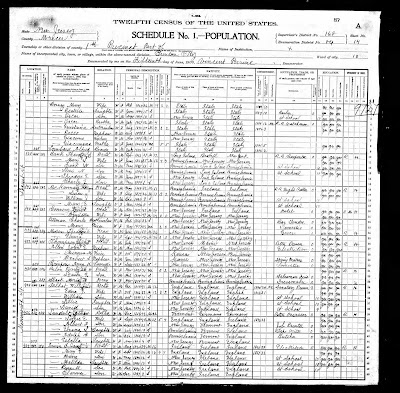
However, when following the paternal line on my mom’s side, there is quite the thick fog when delving into the 19th century. While I have been able to have a relatively complete record of my great great grandfather’s life, his father remains a mystery. Unfortunately, trying to find a specific William McKenna among the waves of Irishmen during the Potato Famine is a task that is difficult to say the least. And while the name isn’t as common in Pennsylvania in the second half of the 19th century as one would think it is still nearly impossible to verify the scarce documents that I do come across.

The other consideration is the simple fact that with limited job opportunities and significant backlash against the influx of Irish immigrants during that time, there are countless countrymen that remain without official records (an informational famine)… even the census has its limitations. In fact, much of the information I have been able to find about this particular generation comes from his children and what they later reported to the census taker and wrote on various documents. In the end, we have what we are left with is a name, approximate year of birth (1840), country of origin, and approximate immigration between 1845 and 1865 (port unknown).

That leaves a rather large pool of potential candidates when trying to sift through immigration, census, limited death records, and family trees. I have a mountain of names and documents that all seem to fit in one way or another but, when I try to put the pieces together, the shape is all wrong. While this is by no means an impossible endeavor, it is one that will take a considerable amount of time, more information, and a few lucky breaks in order for us to find this generation during my lifetime. And, unfortunately, I know I am not the only one who faces this challenge.

Tuesday, March 17, 2015

Finding The Kelly Green Leaves


There are certain days during the year when everyone seems to assume the same nationality for one reason or another. Some people do it because they like the color green, some because they use it as an excuse to drink, and others because they just enjoy the atmosphere of the day. However, for many of us it is an excuse to look deeper into our roots. St. Patrick’s Day is probably the best example of this community participation.

Being Irish was not really something that was a focus for me growing up. In fact, nationality was never really something that was a focus for anyone in my family. We were all born in the United States, our parents were, our grandparents, and our great grandparents so the tether to the boat was quite long. It wasn’t until we really started taking a closer look in recent years (at least for me) that I became more interested and connected to the various heritages that I carry with me.

It started on my dad’s side as I still remember driving down to Virginia in the summer of 1987 and spending the long weekend at the family reunion. This was a little different than the typical reunion that comes to mind as each person in attendance could trace back to the original German/French ancestor that arrived in Philadelphia on 27 October 1764. Good luck trying to figure out how you’re related to each person.

We never knew much about all the other branches on my dad’s side but that has developed substantially over the past decade or so. There is far more than just German blood in that tree as there are lines across various parts of Europe as well as deep native roots her in the United States. However, while there is an assortment of nationalities, there is only a faint touch of Irish blood on that side.

Much of my Irish heritage comes from my mom’s side of the family and, growing up, we were never certain that some of our leaves were a vibrant Kelly green. Once we put a few pieces together and determined that the original surname was McKenna there was little doubt that the family’s arrival in the middle of the 19th century was from Northern Ireland. Tracing your Irish roots back to the potato famine isn’t very unique but at least now we know.  

Like my dad’s side, my mom’s side of the family is also an interesting mix coming from various parts of Europe. And just like the German blood is thick on one side, the Irish blood is thick on the other. Actually, given the tendencies of each, it might be pretty watered down. So have a drink… you may find out one day that you’re Irish. Sláinte!

Sunday, October 27, 2013

I Would Like To Thank The Academy

Yesterday was not a day to sleep in. It was an early day that, despite the long hours, seemed to fly by leaving me wondering where the day had gone. Having staggered out of bed around 5:30 in the morning, it was inevitable to have the feelings of “what the heck am I doing up at this hour.” But once I got on the road, I began to get excited for what I was going to learn that day about the craft.

After picking up one of my fellow brothers in Bryn Mawr, we slowly made our way westbound on the Pennsylvania Turnpike and through the twisting and turning roads of Lancaster County. Driving up to the impressive gates of the Masonic Village in Elizabethtown, we couldn’t help but be impressed by its grandeur and expanse. Fortunately, even though there were a few wrong and missed turns along the way, we made it to the meeting just as registration was opening up.

It didn’t take long before we ran into a few brothers we recognized and a couple that we knew by name which filled the first hour of the event with catching up and talking about our future plans both at the lodge, in freemasonry, and with Scottish Rite (both of us are still within our first year). However, what dominated the conversation was our excitement about the speakers that we were about to hear. For many of us, this was our first experience with the Academy of Masonic Knowledge and so we didn’t know what exactly to expect but, for me, having been to numerous other presentations and readings in and out of the masonic world I knew what we were in for and I was looking forward to it.


In a bit of a switch in the schedule, Brother Arturo DeHoyos, PM, was up first. While his original topic was going to be on Masonic Ritual, he decided to take advantage of the time of year and speak about the images of mortality in Freemasonry. Keep in mind that Brother Arturo is someone that, given his background and experience, you give him your undivided attention regardless of the subject matter. Brother Arturo DeHoyos, PM, is currently the Grand Archivist and Grand Historian of the Supreme Council, 33°, Scottish Rite of Freemasonry for the Southern Jurisdiction of the U.S.A., a member of the Executive Staff of the House of the Temple, and the Grand Archivist of the Grand College of Rites of the U.S.A. He is America's foremost authority on the history and rituals of the Scottish Rite, an author, editor, and translator of many books and articles on Freemasonry.

Needless to say, we were all left thinking about what we had seen and attempting to remember and process all the information that was given to us in a matter of 45 minutes. Shortly after his talk, we spent some time in a Q&A session that was, for lack of a better term, astounding. The amount of knowledge (and I am talking about pinpointing exact dates, people, events, resources, etc.) is something that I don’t think I have ever seen before and will never see again.

Appropriately, following the lively discussion with audience members (I was too much in awe of this man’s intellect to think of a question) we were given some time to digest by adjourning for lunch. Masonic meals at larger events have always been a great way to meet other Masons from all parts of the commonwealth. Doing so allows for greater fellowship both during that particular event as well as future events when you may run into them again.

 
With our stomachs full and much left to process in our minds we were on our way back upstairs to hear the second speaker of the day, Brother John Belton, PM, who spoke on The English Masonic Union of 1813. This was a topic of great interest to all in the room as we are a unique group of masons that differs greatly in ritual as compared to all other parts of the United States and much of the world the only exception being that of the Grand Lodge of Ireland. Given my Irish ancestry, I was intrigued by what I might find out in this presentation.

To give you some background, Brother John Belton, PM has been a regular writer on topics of current interest relating to the role of Freemasonry in society. In 1998 he became the founding Senior Warden of Internet Lodge No. 9659 UGLE. His research has focused on the decline of Freemasonic membership across the English speaking world and has been published in AQC and Heredom. His most recent book, The English Masonic Union of 1813, was published in 2012.

It is a fascinating discussion and one that I look forward to exploring further as I read his book which I purchased at the meeting. I am also curious as to the relationship between Irish and English ritual since the union in 1813 and whether there are slight differences in the rituals of Northern Ireland given their ties both to Ireland and Great Britain. While we discussed the lack of a noticeable difference stemming from a question I posed in the second Q&A session it is still something that I believe is worth exploring further.

Both of the presenters left me with a great sense of uniqueness in the masonic world. Having heard my heritage spoken about (both the Irish and German sides were explored in vastly different ways) and the singular nature of Pennsylvania rituals in the United States, I could help but feel uniquely privileged for being a part of something that holds such a substantial role in the history of the brotherhood. It is this feeling that I look forward to sharing with my fellow brothers at my lodge and something that I look forward to exploring further both in my own reading and research as well as at addition meeting of the academy.

Thursday, October 24, 2013

Happy Unday!


For some, including many of my fellow Rotarians, today was one of celebration as most of the world celebrated United Nations Day. There were long speeches given and countless messages of peace and recollections of what the UN has done for the world. And I am one that whole heartedly agrees that the UN has done some phenomenal work to make this world a better place.

However, this international body is a shell of what it once was and the blind faith and loyalty that some have given to this misguided body is naïve at best. What was once a means to ensure the freedom of people around the world has veered so off course that now they are trying to strip United States citizens of their rights and their freedom like they have in so many countries in recent years. How sad it that?

What makes the situation even worse is the fact that this ‘impartial’ body of, let’s be honest, politicians refuses to enforce any real sanctions that would have a measurable impact on the nations of this world that have promoted and preached hate over the last several decades (and longer). Oh, that’s right, we can’t punish those who deserve it because they may not like us and that wouldn’t be nice. After all, if I make them mad they might break my rose tinted glasses.

However, what is downright shameful is the way that the UN has treated Israel while pandering to the Palestinian Authority. Almost every time, if not every time, Israel defends herself against countless attacks who is the one that gets blamed by the United Nations for the ‘hostilities’? That’s right; Israel is the one that is blamed because they gave a quick jab to the jaw of someone that was running at them throwing haymakers.

The UN has been diluted into a delusional CF comprised of castrated politicians that more closely resemble a fanny pack (those in Ireland will understand what is truly meant by the use of that expression) rather than a just delegation of international representatives. So, rather that celebrating UN Day, from now on I am simply going to consider it an unday. A day when we think about how far we have come and so far we have gone off track.

Hopefully, the United Nations can resurrect itself and realize that the utopia that rattles around in their heads is by no means reality and if you want the support of the people you must support and uphold the rights and freedoms of the people. The UN must be in opposition of those try and strip us of our rights. They must oppose those who serve as catalysts of conflict.

It is time to stop being pukes and start acting like a drill sergeant…


Saturday, June 22, 2013

Who Needs A Mirror?


Can you feel the pain of a previous generation? Do your ancestors speak to you? Sometimes I run across something that, in the past, would not have bothered me but now, with my newfound genealogical knowledge, causes me to stop and think. Our recent trip had one of those instances (look for a longer post tomorrow about our travels).

“HELP WANTED // NO IRISH NEED APPLY”

This sign really hit me and it nearly stopped me in my tracks when I saw it at the Old Jail Museum in Jim Thorpe, Pennsylvania. It plays on both my heritage and my current employment situation. As many of you know I have been experiencing a great deal of flux in my employment situation. I have been working an hourly job at night to pay the bills (or at least some of them) while I try to land a better paying job preferably in my chosen profession of public relations.

Thousands upon thousands of Irish flooded into the United States during the time of great famine in Ireland during the 1840's and 1850’s. Many were greeted with the sign above and were forced north to the anthracite mines. They worked grueling hourly jobs to do what they could to support their families.

This sign both helped me to bond with the men in my family who fled Ireland, were met by those same signs in Philadelphia, and were forced to work in those same mines.  At the same time, it makes me appreciate all that I have... my situation is nothing compared to what my ancestors had to deal with. This should be motivation to anyone to keep pushing forward; this is my motivation that I will find the right position, we will find the right home, and we can find the right balance.

If you let the sign tell the story you will find yourself in the sign.