Showing posts sorted by relevance for query Sunday Search. Sort by date Show all posts

Sunday, March 15, 2015

Sunday Search: Tree Changes


Today begins another regular series of posts that I hope to write each week, Sunday Search. For the most part, I will be writing about genealogy related subjects including recent additions to my family tree, interesting resources or programs, and discoveries that give greater depth to the lives of my ancestors. There is also the plan to write small biographies similar to those that I have done in the past most notably of my grandpop, great grandfather, and great, great, great grandfather.

While there are grand plans for this series, I start today very simply. Recently I had to make a couple of updates to my tree. One that I had been dreading for months and the other that I have been looking forward to since last summer. Two changes that clearly demonstrate the dichotomy of the basic information that we all compile as we trace our roots… birth and death.

Both of these additions of information are almost surreal after having spent so much time digging through centuries of family history and piles of ancestral records. It is a change in perception I would previously dig through pages and pages just trying to find out when someone died but now, having experienced that last moment, it was not something that brought me any enjoyment whatsoever and by doing so, I think back to all the other times that I had to record that information for other loved ones in my tree.

From one unique experience to another. There are names that I see over and over again on both sides of my family and by adding my son’s leaf, one of those names repeats itself for another generation. But the name we chose, especially the spelling, was a means to connect my tree and my wife’s tree. Our son’s name adds to that bond between our deeply rooted family histories.

While he certainly doesn’t comprehend any of this now, I look forward to the day when we can introduce our son to his entire family and the history that his name carries with it. Between the two trees, there is a complex history spanning much of the world. My family touches on many areas and different cultures and my wife’s family covers a completely different geography and part of world history.

Each leaf has a little more to add to the family history just as each piece of fall foliage adds to the autumnal landscape. All different trees offering a different variety of colors but working in unison to tell the same story. That is what our son has to look forward to and what I am looking forward to sharing with our son.

Sunday, May 3, 2015

Sunday Search: Revolutionary Resources


As I have peered through the leaves in my family tree and followed branches out to their blooming tips I have come across a numbers of lines that can be traced back to the time of the American Revolution. Whenever I discover and ancestor that lived in the United States during this time period there are a few resources that I turn to in order to find out if there is any record of their participation in the war. While these resources don’t guarantee an answer (there are a lot of documents that have not been digitally archived at this point), it does offer a convenient starting place.

The first site that browse it the one where I keep my tree, ancestry.com, which has added a number of relevant documents lately. I first look to find any source material that may be available with particular attention paid to the SAR applications that come up in searches. Whether I find something or not I next browse the trees of other members to see if they either have the information that I couldn’t previously find or if they have any additional information that adds to the developing story. While there have been occasions when the family history has already begun to unfold, there have been many instances when nothing has come about from this primary search.

Whether I am already working with results or not, I next turn to another favorite source, the DAR patriot database. This site offers another layer of research as by inputting the name of the ancestor in question, you can find all applications that have been submitted using that ancestor as their proof of ties to the American Revolution. There have been a few occasions when nothing has come up on ancestry.com but numerous applications appeared in the DAR database.

If you find a match here you can request a copy of the application which provides additional information including the sources used to verify each generation and the patriotic service. While it does cost $10 per record, it is a wealth of information that can save you a lot of time. Also worth noting is that SAR and DAR applications can be referenced in your own application to these respective organizations… this reduces the burden of proof down to that of the generations needed in order to trace back to an overlapping ancestor on an existing application of a member.

The last place that I search for information is on fold3.com. While this can be utilized early on I have found that without a membership there can be too many frustrations that prevent me from verifying or disproving service. However, there are occasions when access is free to certain collections (last month was the Civil War while this month is WWII). When access to Revolutionary War documents is free for a certain period, this is a tool that I will employ earlier in the process either prior to or after an ancestry.com search. Once I finish this stage of the process there is a fairly certain answer resulting from my efforts as to whether an ancestor participated in the Revolution. Surprisingly, more often than not, I have been able to find the sources to confirm their participation.

Of course, there are other sources that sometimes provide additional insights. There have been a few instances when the obituaries found on geneaologybank.com have led to the discovery of revolutionary ancestors. This has also been a resource to confirm based on newspaper articles. However, keep in mind that this is just one process for one period in history. It is the method that has worked best for me and has proven to be the most efficient means to finding the answers that I am looking for. It may not work for everyone but it may be useful for some of you. Let me know and, of course, feel free to share your tips and processes below.

Sunday, August 2, 2015

Sunday Search: Putting The Pieces Together

Picture taken during my visit to Leverington Cemetery in 2003. 
In recent months I have made a little bit of progress on the family tree tracing back a number of lines a couple of generations and finding out a few additional details of some of my ancestors. One line that I keep coming back to lately is that of my great great grandfather, John Uttley. While I never knew much about this line growing up (and I still kick myself for not talking to my grandmother about genealogy when she was alive), there has been a lot of progress made in finding out some of the details.

Last year, through online research, reading through a variety of books, sorting through brief mentions in the local newspaper, and calling various city offices, I was able to piece together a few facts about John Uttley and his career in the Philadelphia Police Department. It wasn’t much but I was able to find out that he was appointed to the police force by Mayor Stokley on May 6, 1876 and assigned badge #596. After over five decades on duty, he retired from the force in 1931 having reached the rank of Sergeant. Because the official records for the police department have long since been destroyed, this is all of the information that I could find on the career of the man who helped raise my grandmother.

The same record that provided me with his retirement year, his death certificate, also listed some very important information… the names of his parents. While I am still search for additional information on the Uttley line, his mother’s tree proved to be more fruitful. John Uttely obviously got his longevity from his mother, Charlotte Noblitt (also found at Noblit, Noblett, and Noblet), as they both died as nonagenarians. In fact, according to her obituary, she was believed to be the oldest living resident in Manayunk at the time of her death at age 93 in 1903.


While death certificates in 1903 don’t provide the same valuable information as later official forms, her obituary did offer some additional leaves as her father, Thomas Noblitt, was mentioned as having served in the War of 1812. This is always great information to find so, with those new details I started looking for his pension application. Days of searching and nothing was found. Could it be that the information in the obituary was wrong?

This happens more often than people realize, when obituaries are written, especially those authored by non-family members, there are assumptions made. Maybe Thomas was older than the reporter realized. Maybe it he wasn’t in the War of 1812. Once I made this adjustment to my search criteria, I found the answers I was looking for. The pension application and supporting documents from the Commonwealth of Pennsylvania confirmed his service in the Revolutionary War. Charlotte was actually conceived later in life long after Thomas Noblitt’s military service… longevity it obviously part of the Noblitt legacy.

Recently, I also made an interesting discovery to expand the branches out further in this line. While attempting to learn more about this line I came across a book, Genealogical Collections Relating to the Families of Noblet, published in 1906 by John Hyndman Noblit. The surname was close enough that I had to take a look inside these digital pages and found that this was our family. Not only does the book contain the basic information that you would find in any family tree but it also has reproductions of the actual documents from the countries where the name was once prevalent. While it doesn’t have everything, it has given me a lot more information to sort through, digest, and add to this part of my family history. And, just think, this all started with a desire to learn more about a single leaf.

Sunday, June 12, 2016

Sunday Search: Just Around The Corner

 Barren Hill Cemetery
This past week I was finally able to find the marriage license of my great great grandparents, William McKannan and Susan Laura Corner. It proved to be a difficult task as like many first generation Irish Americans the McKannan surname has been recorded in a myriad of different ways. While I was familiar with the current spelling and the way by which it was recorded for my great grandparents and grandparents in the 1940 census, McKenna, this new document brought to light another possibility, McCann. However, every single one of the other details in the document where accurate leaving no doubt in my mind that I had finally found one of the family records that had eluded me for nearly a decade.

Marriage License - 9 December 1890
When looking at this record I was surprised to find that the marriage actually took place on 9 December 1890, only five days prior to the birth of my great grandfather William Jacob McKannan when my grandmother was seventeen years old. Seems as though there may have been a little rush to the alter to say the least but the marriage did last for the rest of their lives so there must have been more of a connection beyond the simple fact of an unplanned pregnancy. Additionally, as I researched the details of their lives, it was fascinating to see the full lives that they had especially with regard to my great great grandmother.

1880 Census
Susan Laura Corner was born in Philadelphia on 20 August 1873 to Jacob Corner and Tamise Culp. Growing up the daughter of a farmer in Whitemarsh Township, Montgomery County, she experienced loss at an early age as her twin sister, Emma Flora Corner, passed away on 17 September 1875. It is unclear how they met but by the time Laura was 16 she was pregnant and by the time she was 17 she was married to William who was six years her senior.
   
Sunday Times Advertiser - 22 January 1928
While my great great grandfather was working for the Pennsylvania Railroad (eventually becoming yardmaster at Morrisville), Laura was busy first raising her family and then, later in life, increasing her social activity among many of the organizations in the Trenton area. This is one of those situations where she may not have had an occupation listed in the census but she did work and she worked hard. This resulted in her being mentioned in the various Trenton newspapers over 140 times during the approximately 30 years prior to her passing in 1949. While she was a founding member of the Get Together Club (seemingly started after her husband’s passing in 1933, she was also active with her Bible Study Class, a member of Iska Council No. 33 (Improved Order of Red Men), a member of Laurel Temple No. 3 (Knights of the Golden Eagle), and, most prominently, she served as District President of the Patriotic Order of Americans and, later, appointed as Director of the National Patriotic Order of Americans Home and Orphanage in Lambertville. In the latter she also held various roles in Camp No. 6 ranging from Orator to Publicist to Trustee.

Sunday Times Advertiser - 2 December 1934
It seems as though both William and Laura slowly moved up in their respective social circles over the course of their unlikely marriage. They had at least 3 children, William, Mary, and Reuben and were married for 43 years at the time of my great great grandfather’s passing after a six year illness (still uncertain as to the cause of this illness). And, by the time she took her final breath only her daughter, three grandchildren, and four great grandchildren remained. Beyond the simple documents that have been found she is remembered as a good hearted, happy, giving, thoughtful, and intelligent mother, grandmother, great grandmother, and community leader. And, in the end, that is really all that any of us can hope for.

Trenton Evening Times - 3 November 1949

Sunday, March 20, 2016

Sunday Search: Local Resources


One of the first resources, beyond that of family members, pictures, and documents, which we all use when we begin our genealogical journey consists of numerous memberships to various websites. Websites like Ancestry.com are great resources and powerful tools to build the basic framework of your family tree but they are by no means the only resource out there and, in fact, there will be numerous holes still remaining once those databases are exhausted. Where the real work begins is when there are still questions to be answered. This is when the local and offline digging begins.

Too often, local resources are overlooked in recreating the lives of ancestors. It may seem obvious to many of us that have been researching for years but these museums, schools, societies, groups, associations, libraries, and local records offices are frequently forgotten by many. It is a sad reality of the current state of genealogical research as most people starting out and many that have been working on their families for some time often fall into the trap of marketing and instant gratification. This is particularly astounding when you consider the fact that these local resources were once the foundation of countless family histories.

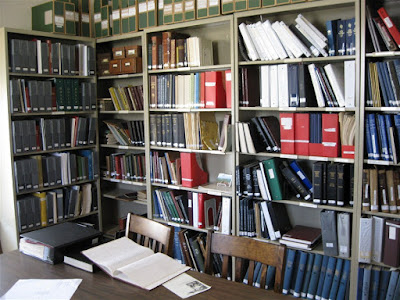
And I must admit that there are many times when I too have overlooked these tremendous resources. Sometimes the most obvious places are overlooked, sometimes they are places that we frequent every week or every month. A great example of this is my local masonic lodge where I have access to all of the records. Knowing that my family has at least a little history with this building and fraternity has made it possible to find some supplementary information that added to the lives of many in my tree. Taking the search to grand lodge widened that group of ancestors even further.

When my family and I traveled to Virginia last summer some of the stops we made we to these local places unavailable online. And, of course, sometime just being in the places, the communities, where my family lived proved valuable to offer perspective to the stories that have been passed down and in adding dimension to the lives of ancestors. Sometimes local depositories are also the only place where the information will be found as has been the case for me with some of the cemetery records near me.

The other important factor is that sometimes when I business closes or moves out of the area, much of the company history is left with the local government, library, or historical society. If you know that an ancestor spent their life working for that company it is certainly worth the time to talk to those local resources. However, the most important aspects to all of this are the simple truths that local resources have local experts who are usually willing to assist you with your research without the exorbitant costs that can sometimes be charged by general sites and/or firms and this research can serve to strengthen your ties with that community whether or not it is the place you call home. After all, those communities are also part of your family history.

Sunday, February 21, 2016

Sunday Search: Paper Or Plastic


Over the past couple of weeks I have been scrambling to find documents and pictures both on my computer and in my files. It seems as though whenever I needed a physical copy I only had it digitally and whenever I needed a digital copy I could only find the physical one. It have just been one of those streaks but it also reminded me of the importance of the need to have family pictures and documents stored both physically and digitally. Simply put, you never know what might happen in the future and you don’t want to be in a position where you find yourself without all the research that you worked so hard to compile.

In my search for certain records and in the stories passed down the family, there are numerous examples of physical photos and files being destroyed by fire, water, or things that have simply vanished. All of these instances happened at a time when the digitization of these records was not possible making their loss permanent. There isn’t a week that goes by when I wonder what information could have been found in those records and the details that we will never have again.

On the other side of the equation. I have gotten to know a number of people in the genealogy community over the past few years and there have been moments when I have spoken to someone who had amassed a massive database of family history which they stored on their computer. Unfortunately, they had not gotten around to printing out all the documents and pictures when their computer crashed. While most of the time it is possible to retrieve the data from the hard drive, in this instance all the records were lost. All they were left with was a few physical pictures and documents here and there… they hadn’t even gotten up to loading everything on Ancestry. It was basically a return to the beginning.

While I am admittedly behind in this endeavor, I am slowly chipping away at syncing my research so that I have digital and physical copies of everything. Note that this includes storage on my computer and on an external hard drive. Once this has been achieved I will begin loading everything onto Ancestry. That’s not to say that I don’t load things to my tree from time to time but there is much more to be shared, more than most people in the family realize. Maybe I will be able to relax once this first big project is done and the ongoing maintenance becomes manageable. However, just stick to remembering the important thing… when someone asks you whether you prefer paper or plastic always pick both.

Sunday, February 7, 2016

Sunday Search: Translation Please!


While conducting searches on different family members there is a variety of information that comes up usually requiring a lot of sorting, deciphering of handwriting, and frustration when the document that really piques my interest is in another language. More often than not I am at least able to figure things out not because I am fluent in multiple languages (I haven’t even mastered one) but because I know the basic format of what I am looking at. This hasn’t always been the case but after you have been doing the same kind of research for a while you generally know what information goes where largely based on where you find the name you are looking for in the document.

Early on in my research, these were pure moments of frustration that usually had me clicking on the ignore button before giving the document half of a chance to reveal itself. Now I find myself revisiting the branches on my tree and sorting through those forgotten hints so that I can again sort through them to see if anything is relevant to my family tree. I guess you could say that this is the curse of the world explorer membership on Ancestry.com.

However, this is only on instance where the language barrier can prove difficult or just flat out frustrating. While Google translate and similar programs are wonderful tools they are generally only reliable when it is strait text on a website. Add in the calligraphy element as well as the fact that most of these documents are in PDF or some other unsearchable file format and there is little that Google can do to assist. And I actually ran into this issue when researching my great grandfathers World War One unit.

When looking for information on the Motor Transportation Corps on the internet there is actually a limited amount of information that can be found as it pertains to the WWI incarnation of those units. When digging even further and specifying Unit 301, there is even less information available. After exhausting the limited resources that populated the first few search pages, I came across a PDF document of an account from one of the locals in France… you guessed it, the document is in French. Unfortunately, I understand very little of this language anymore having forgotten nearly all that I was taught in school and Google translate refused to assist in this matter.

Thankfully it is a typed account and a common language. Older documents found in dusty books are proving to be much more difficult. However, many are in the formats of which I am familiar and have provided me with a wealth of knowledge that has been added to my ever expanding genealogical database. But, and I will leave you with this thought, it would be nice to have the ability to instantly translate the material and I encourage researchers to know at least one other language and have a network of researchers who know a variety of other languages as well. You never know when your knowledge or theirs will benefit your research.

Sunday, October 4, 2015

Sunday Search: Unintentional Intentional Errors


Every once in a while I will receive a message through my Ancestry.com account regarding some of the information in my family tree. Sometimes it is about documents, photos, or certain details that I have discovered elsewhere and uploaded to the website which I am happy to share and discuss with anyone who contacts me… you never know how you might be related. However, most of the time, the questions and corrections are regarding the very tips of the limbs that I have yet to fully research. In these instances I reply letting them know that the research has yet to be done and the information is stemming from scant documents that have been uncovered. This is usually followed by an invitation to share any information they might have on that individual or, as has been the case a few times, the correct name that should inscribed on that leaf.

This all comes down to how each of us use Ancestry as a genealogical research tool. While many people refuse to enter information in to their tree until they have verified the content, I prefer to use the website to both record known facts and figures but also theorize as to those names that may consist of the next generation. Sometimes it can be stemming from information culled from documents and other times it is a much more general estimation given the age of children, where subsequent generations lived, and sometimes the information that has been passed down in the family.

Even the most basic of estimations have sometimes led to the information that I have been looking for. Many times I have entered the surname and approximate year of birth to find only a handful of possible people who could fit into my tree. After looking at all the records available, I was able to not only find the right name but verify that, yes, they are my ancestor. All it takes is that small detail and a little bit of deduction in order to begin chipping away at that wall. This is the process that has worked for me and has kept me somewhat organized in my research thought process over the years.

Of course, with this being my process it leaves a number of assumptions wilting under the sun on the end of the branch until I am able to make the time to prune them but I know that the information is there and I don’t have to worry about retracing some of my steps over and over again when I find the rare moments to search for that next generation. Again, while not a process for everyone, it is the one that has worked best for me so far. Now if I could only be so organized with all the photos, documents, and notes cluttering my office.

Sunday, October 11, 2015

Sunday Search: Exploring The New Ancestry


It has now been some time since I updated my ancestry.com account to the new format. I was a little hesitant to do so as I felt I was just starting to really get a handle on the old site. Besides, what would I really get out of the new format if I wasn’t able to find everything that I wanted? But, not having the time that I used to have to comb through the digital volumes that I once had and getting tired of the constant requests to upgrade, I finally just decided to go ahead and make the change. After all, the constant promotions promised an enhanced experience far superior to the supposedly antiquated site that I had been using so let’s see what all the fuss is about.

Well… there isn’t much difference between the old site and the new one. At least, nothing significant that I have noticed in my occasional browsing through files, searching for documents, and skimming across the vast family tree that I have constructed. While I can clearly see the shiny new layer of digital shellac, where is the revolutionary change in functionality? It was really a letdown when the new site was laid out before me on the computer screen.

With that said, there is one minor feature that I particularly enjoy but it isn’t anything that will rock the genealogy world. While I am constantly cognizant of the world and sometimes local events that took place during the lifetime of my ancestor, ancestry now has those historical reminders integrated into each family member’s timeline. And I have to admit that it is helpful from time to time having those simple reminders clearly displayed on the screen.

Other than that, I haven’t come across anything that is making things easier or more interesting… of course, my family history is already deeply fascinating so it would be hard to enhance that. At the same time as the update were occurring, ancestry.com kept making more and more collections available for search… these have been more useful than the prettier package that the website is now offering. This is what made me think, what if they put their money and effort into making more documents available rather than redesigning the website? How much more data would we all have access to? What could we have already discovered?

That is, first and foremost, where the focus should always be not on how fancy the site looks but what information the site contains. So I ask ancestry.com to spend those membership dollars on data not on spit and polish. After all, the reason why we give you our hard earned money is to learn more about our family not the fanciness of the page framing the digital document.

Sunday, August 23, 2015

Sunday Search: Missing Documents


Over the past few months there have been moments when I have made surprising progress researching my family trees and there have also been instances when I have hit some pretty significant walls. No matter how hard I have tried to hit the brick or how heavy the hammer, the structure remains solid. While there is still some small glint of hope that these records will turn up, it is not an endeavor that will likely produce significant results anytime soon… I guess I will have to get the chisel out and try to find the answers that way.

After all, that is how I found the few details that we know about John Uttley’s service in the Philadelphia Police Department. After dozens of calls and many hours leveraging various resources I was able to find out that while the full personnel files have long since been destroyed, there are pieces (i.e. rank, badge number, date of swearing in, rank, accounts in the newspaper) scattered across multiple sources. It isn’t much but it is a heck of a lot more than we have had in the past. Other endeavors haven’t even produced this level of information.

My great grandparents (William Edgar Yeagle and Bessie Wirth Uttley) divorce is something that is still interpreted different ways depending on with whom you speak. His first family, which is my line, sees the dissolution of marriage in one way namely that it was his drinking and abuse that caused the divorce. However, his second family, according to his granddaughter with whom I briefly spoke a couple of years ago, sees things a little differently in that it was my great grandmother that caused the issues in the marriage. When I called the court records office in Philadelphia City Hall (where they got divorced), there was little information that they could share as the records have long since faded and the only information on hand was that of the actual decree (without mention of cause). But at least that record can be produced unlike some others.

The marriage certificate of Paulus Redcross and Frances Beverly continues to be one record that we are continuing to search for through various offices, depositories, and whatever other means out there. It is something that we know exists as it is recorded in the Amherst County, Virginia ledger but the actual document seems to have disappeared. Not faded or destroyed (as far as we know) it is just gone. No one has been able to provide any definitive explanation although there are plenty of theories out there which is a completely separate topic altogether.

All of these documents have the potential to provide my family with a wealth of information (and answers) beyond what the existing documents ever could but there is significant doubt as to whether we will ever be able to read them. While we will continue seeking answers to other questions and look to fill in the family tree, these are things that we will always be looking for even if the possibility of finding them is slim. While these situations may be a deterrent for some, it only serves to motivate me to find and write the story without them (or at least try).  

Sunday, May 1, 2016

Sunday Search: Confederate Service


Following my records request that I filed with the National Archives a few weeks ago I decided to do a little more digging into the service of George William Clapsaddle during the Civil War. It seemed odd that he would have been discharged less than a year after enlisting in the 28th Virginia Infantry. This was especially intriguing as there was little information on ancestry.com including the vague details found in his application for assistance from the Federal Government that he filed on 10 November 1902. 

While I am still waiting on the documents from the National Archives, the next logical step was to reach out to the local chapter of the Sons of Confederate Veterans. With the few details that I had been able to record, I posted my query to their Facebook page and, through the assistance of a very helpful member of the group, I was able to learn about a few more details about my 3rd great grandfather. Following our discussion, I turned my focus to fold3.com (I have a membership but, too often, I neglect to search this site) and was able to get a much more complete picture regarding his service in the Confederate Army.

George William Clapsaddle was born on August 29, 1834 to John Jacob Clapsaddle (who also served in the Confederacy even at his advanced age at the time) and Catherine Rinehart. One of four known children, he grew up on a farm in Botetourt County, Virginia. According to records, he enlisted in the 28th Virginia Infantry (Company K) in Amsterdam, Virginia by Lieutenant Robertson on 20 July 1861 (one day before the regiment’s participation in the First Battle of Bull Run (Battle of First Manassas) and, despite originally enlisting for a period of one year and having not received any pay, he was “Discharged from military service… by Secretary of War” at Fairfax County Court House in Virginia on 30 September 1861. Later documents recording the receipt of back pay show that he was discharged on December 28, 1861.

While there is no supporting documents from 1862, it is likely that, after having received compensation for his previous service, he immediately reenlisted in the Confederate Army this time serving in the 12th Virginia Calvary (Company E and D). It is possible that, during this time, George Clapsaddle participated in what would late be called Stonewall Jackson's Valley Campaign in the spring of 1862. However, it was while in service of this company that he was captured by Union forces at Charleston, Virginia on June 15, 1863, charged with assisting in the capture of cavalry officers and sent to Fort McHenry, Maryland and later Fort Delaware, Delaware.

After being included in a prisoner exchange on July 30, 1863, he returned to the 12th Virginia Calvary where he was once again discharged. In early 1864, he enlisted for a third time this time serving as a private in Captain W. Hays Otey’s Company of Virginia Light Artillery in charge of local defense and assigned to the Confederate Arsenal Ordinance Depot in Danville, Virginia as a machinist where he served until the end of the war.

After the war, George Clapsaddle returned home, resumed farming, and married Margaret Ann Bowyer (daughter of Joseph Brown Bowyer and Elizabeth Betsy Stevers) on November 30, 1865 in Fincastle, Botetourt County, Virginia. They would go on to have eleven children including my 2nd great grandmother, Sallie Betty Clapsaddle, who was born June 20, 1870 and married Roy H. Teaford on June 21, 1892.  

Late in life, while living with his oldest surviving son, Ray, he did apply for assistance from the Federal Government which he filed on 10 November 1902. While it is unknown whether he ever received assistance, what we do know is that he passed away on December 16, 1916 at the age of 82 not from old age but rather “epithelioma of upper lip, nose, and cheek”. While not specified, it is likely that it was a cancerous growth from which he has been living with for two years prior to his death. He was laid to rest, along with his story, in the cemetery at Galalia Church in Gala, Virginia.

Sunday, October 18, 2015

Sunday Search: The Samuel Ardis Mystery


One of the first things I noticed when I initially began compiling my family tree was how many ancestors grew up not knowing either their mother or their father. One of the other examples that I have previously written about was that of Jacob Worth who remains interred with his fellow Union soldiers at the bottom of Mobile Bay having fallen victim to a Confederate torpedo while aboard the USS Tecumseh. This is a tragic tale but one which has the documents and facts by which we can determine exactly what happened. That isn’t always the case which is what I faced when looking at the life and death of my great great grandfather Samuel Warner Ardis.

The day following his early demise, on Monday, September 1, 1902, The Philadelphia Inquirer printed a story under the sensationalize headline “DEATH USED PHILADELPHIA AS A TARGET” with one of the many bulleted subheads stating “Element of Mystery in Case of Samuel W. Ardis Dispelled by Investigation”. Having been printed only a day following his death, the coroner’s inquest was still pending but the details suggested that heart disease played a factor. However, some of the details remained a bit fuzzy.   

To that point the investigation suggested that Samuel Ardis, who was employed as a clerk with the Reading Railway Company, was taken in by a stranger on his way home after falling ill shortly after his departure from work. Early the following morning, Sunday, the police were notified that Samuel Ardis had died suddenly at the house at some point during the night. When questioned later, my great great grandmother stated, according to the report that she was in “total ignorance of her husband’s movements since Saturday”.

While the autopsy later revealed, and was recorded on his death certificate, that the cause of death was pneumonia, we will never have a complete picture as to what transpired that night. The only facts that we know are that he died just over a month after his 3 month old son, Thomas J. Ardis, passed away and left his wife to care for their only remaining child, my great grandmother, Sarah Mabel Ardis, who turned three only four days after he baby brother died. In the span of just over a month, my great grandmother lost her father and her brother with her birthday falling in between. I can’t imagine what must have been going through her, or my great great grandmother’s, mind as all of this is happening.

We know a little but the mystery, and questions, still remain… Did he knock on a door or was he found and brought inside? Did he know the people / person who took him in? If so, how did they know one another? Did he know that he was sick? Did anyone notice at the office or was he seemingly ‘fine’? Why weren’t there any signs that this could happen? All these questions I want to have answers to but know that will probably never happen.

Sunday, August 9, 2015

Sunday Search: Rediscovering What Was Already Discovered

The early days... it was easy to keep organize with few files. 
My wife and I decided to dedicate this weekend to cleaning and our son finally let us get the much needed work done around the house. With the washing machine humming, sloshing, and twirling in the background, we went from room to room cleaning, organizing, sorting, and packing. It took the entire weekend to get most of the house done and by the time my wife went to bed on Sunday night the only two rooms remaining were our offices. This is a wholly different task altogether as we both have more paperwork than storage space and more books than shelves. It is going to be interesting but hugely satisfying when it is done.

With my wife and son asleep, I ventured down into the basement and began sifting through the rows upon rows of shelves. I went down there with the goal of filling one box of books that had little value to me at this moment. As someone who enjoys information and having resources readily available, this is not a very easy process… many of the books that I have collected over the years are those that contain information that has yet to be digitized. Contrary to what some people say, not everything can be found on the internet. After about 30 minutes, I actually was able to fill a box and clear a shelf for the binders of new research that was going to be added. It came down to a small sampling of books that I know I can find again when I have the space.

Once this part was done, I began flipping through the binders on the shelves and files stored in boxes. It really is amazing what you can find when you it down and sift through the boxes in your office… this is especially true when it comes to genealogy. While slowly flipping through the pages and pages of notes and photocopies, I rediscovered small details that I had written on a pieces of paper while pouring through volumes and volumes of material. They are the small details (like the fact that my great grandparents were brought together by their love of horses) that I had forgotten almost as quickly as I was able to record them.

It is the dilemma of disorganization. While many of the documents and facts have been sorted and organized for later, many of these details seem to get lost in the pages. At the same time, rediscovering these details was just as interesting as when I first read them. It was nice to feel that same way about finding ‘new’ information and it makes me wonder what other documents I have buried (most likely from a scanning / photocopying marathon). With the rest of the house in order, I am glad that I am now in a position to take on this task… at least until the files get moved again.

Sunday, July 5, 2015

Sunday Search: Our Towns


With the reunion having concluded yesterday, we filled Sunday with a variety of stops and places that I wanted to see during our extended vacation in Virginia. We filled much of our morning with a few trips to some local cemeteries but that is a post for another day. This post is about where our family lived both in the early part of the 20th and latter part of the 19th century.

Before moving up to Pennsylvania, my grandfather was born and raised in Eagle Rock, Virginia. This is where all of my great aunts and uncles were born as well. I guess you could say that it all started at the Eagle Rock Baptist Church where my great grandparents, Harry Teaford and Nettie Love, were married in 1917. For the first time, I was able to see the church thanks to my great uncle serving as our tour guide for the morning.


Of course, before we received this guidance, we were left on our own to explore the small town. While it is clear that it was once a nice little mountain community, the town seems to have never recovered from the depression that drove my family north.


While the train station still looks like it is in good working order…


…the car dealership has obviously be lacking that new leather smell for some time.


This is obviously not a touristy type stop but it where we come from and it is the first time that I have been able to walk the streets and probably the first time that my father had been there in about 50 years. While pictures and documents make up much of work in genealogy, places are also an important part of the process. Walking the same streets and seeing the surrounding mountains gave me a much better understanding of the generations of my family that called this small town home.

Later in the day we met up with a cousin in Fincastle (as well as my aunt and uncle who also joined us for the afternoon). Surprisingly, we were the only ones that took her up on her offer yesterday for a tour of the capital of Botetourt County. Many of our family documents can be found in this building so I was looking forward to finding out a little more about the town itself. We all convened at the local museum and proceeded to walk the town as the humidity continued to rise.

Just in front of the museum was the county courthouse…


…which served as the gateway to the west when this now modest county extended far beyond its current boundaries and deep into the Midwest. It is because of this distinction that the courthouse is recognized for its place in the Lewis & Clark Expedition.


From the courthouse we walked up and down the main and back streets of Fincastle…


…passing numerous historic sites and old houses…


…and quite a few churches including the one below which dates back to before the Revolutionary War.


The town tour ended where it began and our generous host concluded the afternoon with a walk through the museum. Of course, the path around the building lead us directly to the research room where we couldn’t help but pour through a few of the volumes stacked on the shelves. While we didn’t uncover much, it was nice to be back in the stacks sifting through all of the names. And, obviously, it was once again nice to have my feet on the same soil and stones that were once walked by many in my family decades ago.

Sunday, July 24, 2016

Sunday Search: Documentation For My Supplemental Application


Ever since I received the letter from the Sons of the American Revolution saying that my application was accepted (actually, our applications), I have been working on my first supplemental application. As I have previously outlined, the first application was tracing back the Redcross line on my dad’s side of the family and now I am weaving my way through my mom’s side. It should be no surprise that the line that I am using for this application is tracing back to John Noblit.  

In addition to the previous difficulties tracing what was a line unbeknownst to us until recently, there was also the task of pulling together some of the documentation for recent generations. Surprisingly, there has been a lot of material uncovered and some tremendous recourses discovered which leaves little doubt about the family line prior to the 1940’s. Not including myself, the recent work has been in pulling together the documentation for the recent generations. Just last weekend, I finally got those last few items that I need to complete my second mountain of paperwork.

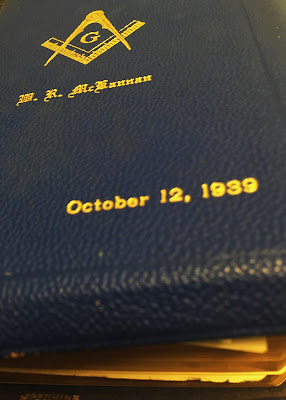
I have known about my grandfather’s Masonic Bible for most of my life and I knew that my grandmother would pull it out every once in a while not necessarily for what was written on the pages but to remember the family members represented by the scraps of paper between the pages. That being said, I had never taken the opportunity to sit down with my grandmother or my mom to really see what was contained within the blue covers. When my mom gave the Bible to me last weekend, I couldn’t help by start paging through the chapters and examining the documents that continue to buckle the cover.


There were certainly some interesting pieces of paper floating loosely between the pages containing names, marriages, birth and death dates, and some clippings from others moments in my grandmothers life including a photo from the local paper and a small clipping announcing a party for my grandparents’ 25th wedding anniversary. Of course, bound deep within the pages of the book is something that I had been looking for… my grandparents’ wedding certificate from 1940. In the subsequent pages I found not only the births of my mom and her siblings in my grandmother’s handwriting but also some of the deaths in the family from the time they were married through the passing of my uncles.

It is a unique opportunity to use this family record in my most recent SAR application and it is also an honor to be entrusted with the history contained in its pages. It is not only a connection to my family history as a whole but a real, tactile, connection to my grandmother and my grandfather. In both regards, I consider myself a caretaker of the family history and I hope to preserve not just the pages that have been passed down but also the documents that have been discovered over the years so that we are never again in a position to forget. 

Sunday, August 30, 2015

Sunday Search: Keeping In Touch

It's never too early to start coloring in the family tree!
After the reunion in July, I was determined to improve my communication with family members both nearby and far away. After all, there is only so much that I can do with regard to genealogy and it is always best to be in communication with numerous family members trying to fill in the different pieces rather than all of use trying to find all of the answers on our own. Additionally, we all have access to different documents, photos, and stories that we should be sharing with one another. That might have been the biggest takeaway from the weekend, there is so much that we all possess and it would be nice for us all to have access to those pieces of the picture and leaves of the tree.

While in the past this would have been a more exaggerated process full of letters and a lot of postage. That isn’t the reality in which we live today. While there are some that still require the letters, phone calls, and face to face meetings, most can be accomplished through email and social media (I will write about genealogy specific online tools in a future post). Thankfully, there has already been a group formed on Facebook to help facilitate those communications and I have been able to connect with those who were in attendance as well as those who were unable to make it over the past couple of months.

Sometimes it is also these simple things that get other family members interest in family history. I have been able to connect with many family members, some of whom to which I have not previously spoken, based on the simple fact that they want to learn more about the family. In other instances, different stories have been shared… some I have heard before while others are completely new to me. I doubt that the correspondences would have come as easily through any other means other than Facebook or email.

Of course, there are a lot more stories that have yet to be told and information that hasn’t as of yet been shared but the lines of communication are open and I am looking forward to collecting and sharing these new tidbits with the rest of the family. Additionally, there is an open invitation to family members (and other with stories they would like to share) to write a post to be included on this blog (the author will receive full credit). So, the reunion turned out to last much longer than the two days in Virginia, and I expect it to continue until we are able to get together again five years from now… we should have a much more colorful and complete tree by then.

Sunday, May 8, 2016

Sunday Search: Mother’s Day And Maiden Names


This Mother’s Day I wanted to discuss an interesting situation that comes about in many of the genealogy conversations that I have with others. Unfortunately, the sentiments that follow are not restricted to those only now just starting their research… I have encountered many knowledgeable family historians that just seem to be stuck in a certain mindset. The issue is rather simple, and appropriate for this day, in that there are too many people only focusing on a fraction of their family history by overlooking the wealth of lineal knowledge that exists in a maiden name.

In several instances lately I have spoken to individuals who can, at great length, discuss the history of their surname and can also speak intelligently about their own mother’s line (and sometimes the lines of their grandmothers). However, that is where there maternal ancestry stops. Once they go back a couple of generations it seems as though they have forgotten that there are multiple paths that we can take into the past through both husbands and wives.

First, let me start with the fact that I am proud to have my mother’s maiden name as part of my own, serving as my middle name. It has allowed me to carry with me the surnames of both of my families and I do my best to remember that each day. Second, now as a father, I better understand the importance of teaching my son about all the families that he represents and I look forward to sharing that knowledge with him. Third, I have explored many of the different lines in my tree weaving between husband and wife and I can attest to the rich tapestry that is revealed when you allow yourself to take this journey.

There is so much more to who we are than simply our male descendants and the surname that we each carry. It is with this in mind that I encourage everyone to not just remember your mothers on this day but all the mothers in your family tree that have each had an impact, large or small, known or unknown, on who you are. Without the women in our family we would not have life… we would not have the layers upon layers of history and the fascinating lacework that is our own family genealogy. Mothers are what make genealogy possible and we should always remember that and honor them by knowing about all sides of the family.

Sunday, September 4, 2016

Sunday Search: Another Reunion!

The family will understand the significance of this photo. 
While we have been planning this weekend for months we have been thinking about it for even longer. Ever since our son was born (especially given the circumstances around his birth) my wife and I have made a conscious effort to preserve our respective family histories that we can one day pass down all of this information to him. Part of this process is making sure that we attend the family reunions whenever we are given the opportunity to do so. Today, and this entire weekend for that matter, we were finally able to introduce our son to my mother-in-law’s side of the family up in New York.

While we have been sharing meals with various family members for the entire weekend, it was nice to have a larger group together for a short time so that we could learn a little more about the family, the different branches, and also the place where many of the roots still thrive. Much like the family reunion last summer, there were people we knew, some we recognized, and others to whom I was introduced for the first time. It was also a great way to introduce our son to an entirely new culture as these family members represented our son’s Italian and New York heritage.

After all, the stories are there, you just have to be there to listen. And when many of the family members weren’t playing with our son they would share their memories with us bringing to the fore both the rawness of recent memory but also appreciation of the time we did have with them. There really isn’t a way to describe that particular experience and that mix of emotions but, in the end, I am glad that we were there and that we are able to provide a connection to this part of the family not just for my wife and I but for our son.

Most importantly, while this was simply another reunion or gathering for some present, it was a means to connect with family for us. Family that shared stories with us that can’t be found in any book but that speak to the character of the family into which I was, once again, warmly welcomed. It was an afternoon and weekend that we will not soon forget and an experience we look forward to sharing with our son many more times in the future. However, next time I just have to remember to not eat for about three weeks prior.

Sunday, November 22, 2015

Sunday Search: Moving Our Archives


As we are slowly getting settled into our new house, all the boxes that I spent packing long into the night are starting to get cut open and the contents roughly organized. Not only are we having to put clothes away, line the books neatly on the shelves, organize the boxes of toys, and get the kitchen put together, we are also having to get all of our binder and boxes of photos and figuring out a system for storing as well as a place to put all of them. Of course, now that we have a home and we are not anticipating any further moves, we are taking things a bit slower this time around and really figuring out a system that works for each of us.

Thankfully, we have enough room in our house that we each have an office to go along with an abundance of storage options. However, with options and wanting to take things slowly this time around, we are falling a bit behind in getting things to a place where we can readily pull out images or information. And with things previously so scattered it was a bit overwhelming when we realized just how much we have… we knew we had a lot but we didn’t fully grasp the sheer volume of research and images that we have collected over the past several years.

With a few more storage options, and more boxes, my wife has figured out her own system. While I have a few less places where I can hide the disarray, I have figured out a way to get organized and have started putting thing in an order that will allow me to pull out information I want fairly easily. Of course, this is only half of it as much of my information is still in a digital format. While there are certain advantages to this I still prefer to have hard copies and many times find it easier to pull up information rather than rummaging through files on my computer.

While there have been many attempts in the past to get all the family information and history organized, we are finally in a place when we can get it done and not worry about what would happen if we had to pack it all up and move it into a completely different space. So, for now, we are going to take a quick break from researching and focusing on the archiving of our legacies. In the end, this can be just as important as finding that next new piece of information.